
I have seen someone claim that by definition our senses are an illusion … or at least our perceptions are illusory. This initially might seem an over-the-top claim. But first let’s take a look at three common or garden ‘illusions’.
This is one of favourite illusions. It is motion induced blindness. Get the image to the centre of the screen and focus intently on the central flashing dot:

If we focus on the central green flashing dot, we can make the one or perhaps even all three of the peripheral yellow dots disappear. Michael Bach’s website his simple explanation:
If you fixate steadily, all structures are imaged on their same retinal location. This leads to local adaptation on the retina (the Troxler effect, often incorrectly addressed as “fatigue”). By adding additional temporal modulation (here the rotation), effectively the background noise is increased. Thus, the Troxler disappearance is more pronounced and/or happens faster.
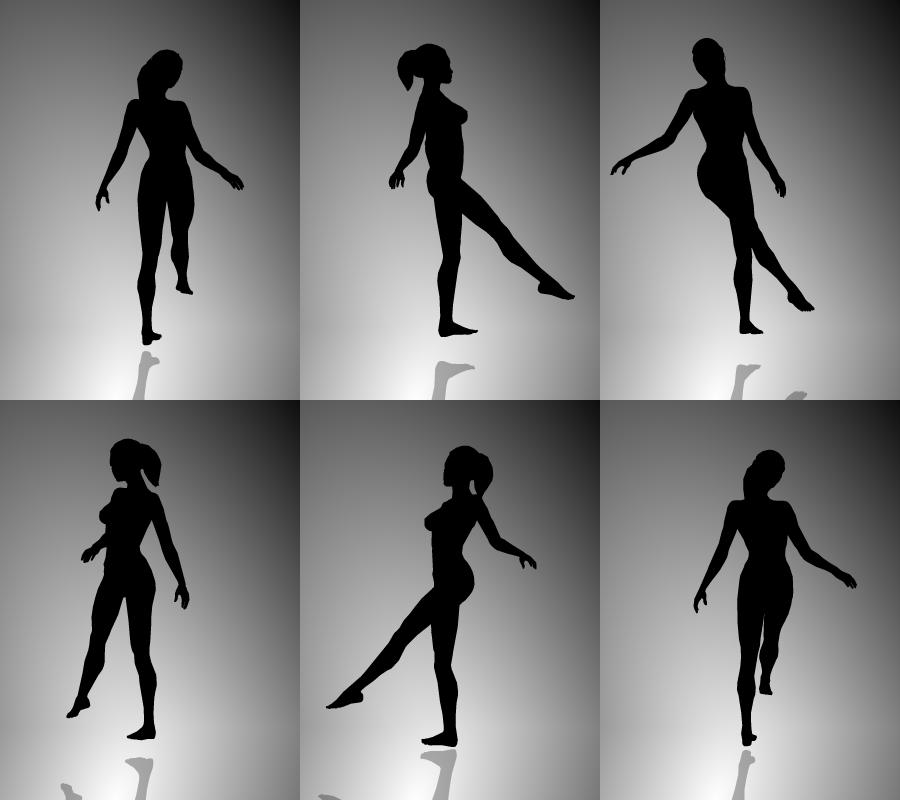
The silhouette on the right is from Wikipedia, and the author of the illusion is Nobuyuki Kayahara. For me she spins primarily clockwise. Though the are moments that she spins anticlockwise.
Bach also discusses this illusion in a bit more detail. He has a more symmetrical version of the silhouette and you can play with it here. This version is a lot easier to flip and reverse the spin. Bach comments that silhouettes are ambiguous, and our brains try to reconstruct a 3D image from a two-dimensional flat surface adding information that is not really there. The thing to bear in mind is that is that we are seeing black (lack of photons) on a background of green, red and blue LEDs flicking on and off. Our brains construct a silhouette image of a dancer pirouetting. Bach’s illusion home page is an excellent resource for all sorts of illusions … currently 135 of them.
The third example of an illusion highlights our lack of awareness to change. It’s actually an advert for road safety with respect to cyclists. But it does highlight how unaware we can be. Can you work out who killed Lord Smythe in this short, but camp video?
OK, assuming you are coming back from the video, that was a little unfair. But if you are like me you probably noticed very few of the changes that occurred during the one minute skit. Zero in my case. At the very least it shows our brains are good at disregarding information that seems irrelevant. Our brains created an edited version of what happened.
Our sense of now seems to be an average of the last three seconds. Do thoughts usefully drive anything or are they (thoughts and consciousness in general) like hum of an electrical motor – noise?
What do we mean by illusion? Many describe their use of the word illusion as not as it seems. Clearly the first two are classic illusions … the yellow dots don’t disappear as we focus. The silhouette is not spinning in either direction. The grey is simply the some of the red, blue and green LEDs being lit up.
The chair or couch you are sitting on is not solid in the sense that there is a continuous material between the various atoms and the atoms themselves have huge space between the nucleus and electrons. Our senses interpret this solid as continuous. Now, this is not saying our senses do not help us navigate our environment. Evolution does not care about the accuracy of the senses. I can’t even say evolution cares about the utility of our senses, only that having senses, however imperfect, has allowed successful replication. We might say (albeit carelessly) our senses are fit for ‘purpose’.
I have no problem thinking (philosophically) of my will, sense of self, awareness, colour, sound, my perception etc as illusory. Most of the time these illusions are fit for purpose. In the same way looking at myself in a mirror transposes images in a lateral direction … almost as though I am looking at the surface of my face from behind. It is not absolutely accurate, but we can make it work.
If determinism is true or indeterminism for that matter, much, if not all, that we experience has to be illusory. This is not a question whether we have an appetite for hard or soft interpretations of determinism.

 rom's corner