
Last summer I did an Ancestry DNA test. I did not expect a lot of surprises, in that, the place of my ancestry is relatively a monoculture DNA wise. Unlike the UK where all sorts of DNA is mixed in and I am not just referring to the recent (last 100 years) of immigrants. Having said that, the Poles, Swedes, Russians and Germans have had their influences in the Baltics. The estimated ranges for my DNA mix are given below.
| Baltic | 64 % to 97% |
| Russian/Eastern European | 28 % to 45 % |
| European Jew | 0 % to 4 % |
And the geographic regions below:
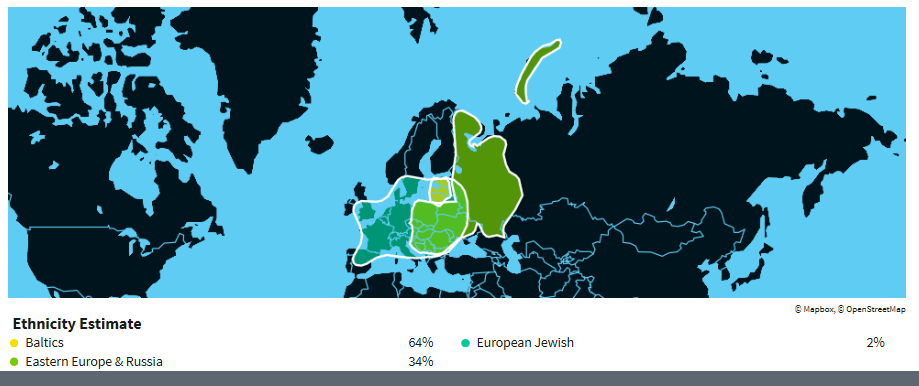
The major players are not surprising, my first language was Latvian and my surname is of Russian origin; so, the DNA analysis seems about right. Note that the estimated mix is subject to change. For example the original estimate contained 3 % Finnish (Suomi), which in later revision completely disappeared.
Below are the blurbs that Ancestry wrote for the different DNA groups
Baltic 64 %
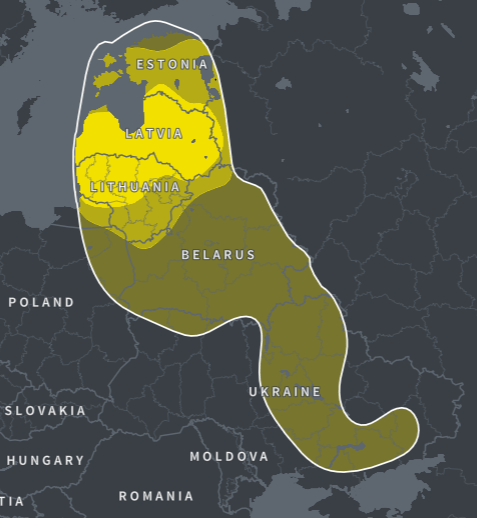
Primarily located in: Latvia, Lithuania
Thousands of years ago, the early ancestors of the peoples in our Baltics region came from the east and south. They entered a landscape of low-lying plains, thousands of lakes, and millions of acres of forest, a beautiful boundary zone straddling eastern and western Europe. Inhabitants have seen Vikings, crusading Teutonic Knights, empires, and Communism come and go, but they have maintained an attachment to land, culture, and freedom
Eastern Europe & Russia 34 %
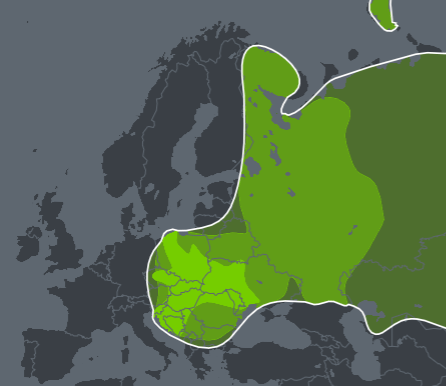
Primarily located in: Austria, Belarus, Bosnia and Herzegovina, Bulgaria, Croatia, Czech Republic, Hungary, Poland, Romania, Russia, Serbia, Slovakia, Slovenia, Ukraine
Our Eastern Europe and Russia region stretches from the Baltic Sea in the north to the Adriatic in the south. The landscape is a mix of mountains, rivers, and plains and stands at the crossroads of Europe and Central Asia. By the 5th century A.D. Slavic peoples were moving west into modern-day central Europe, followed by Magyars, who settled Hungary. The Slavic peoples are now the largest linguistic and ethnic group in Europe, and the region’s legacy of beauty and civilization lives on in famed world cities such as Prague, Kiev, Moscow, and Budapest.
European Jewish 2 %

Primarily located in: Poland, Belarus, Ukraine, Russia, Hungary, Israel
Our European Jewish region is not geographically defined in the same way as most other ethnic regions. The historic dispersal of the Jewish population from its origin in the Levant on the east coast of the Mediterranean resulted in insular communities scattered throughout Europe, North Africa, Central Asia, and the Middle East. Although some Jewish communities enjoyed positions of relative peace and prosperity, many more were segregated from mainstream society by law, custom, and prejudice, experiencing sustained persecution and discrimination. Jewish populations from northern and eastern Europe are often known as “Ashkenazi.” “Sephardic” refers to Jews who were expelled from Spain during the Inquisition and mostly settled in North Africa and southeastern Europe.
Relativity and Genes
As I said, the Baltic and East European/Russian connections were of no surprise. The 2 % Jewish connection, was a little bit of a surprise, in that it was never mentioned in family discussions; though in hindsight it is not unlikely.
Anyway, as far as I can tell none of my relatives that I am aware of have done an Ancestry DNA test. I have a relatively good feel for the family tree on my mother’s side; but, my father’s side is pretty much a mystery. The closest relative that showed up was one of the following: a second cousin (once removed), a half second cousin, third cousin or there are other possibilities due to the chaotic transfer of genes. Having said all that there were forty-five “fourth cousin” matches, relatives most of whom I have to be unaware of.
A typical genealogy map can be found below, it gives a sense of relatedness, the amount shared DNA. Many versions of this can be found on the internet, take with a pinch of salt. And as implied above these are approximations.
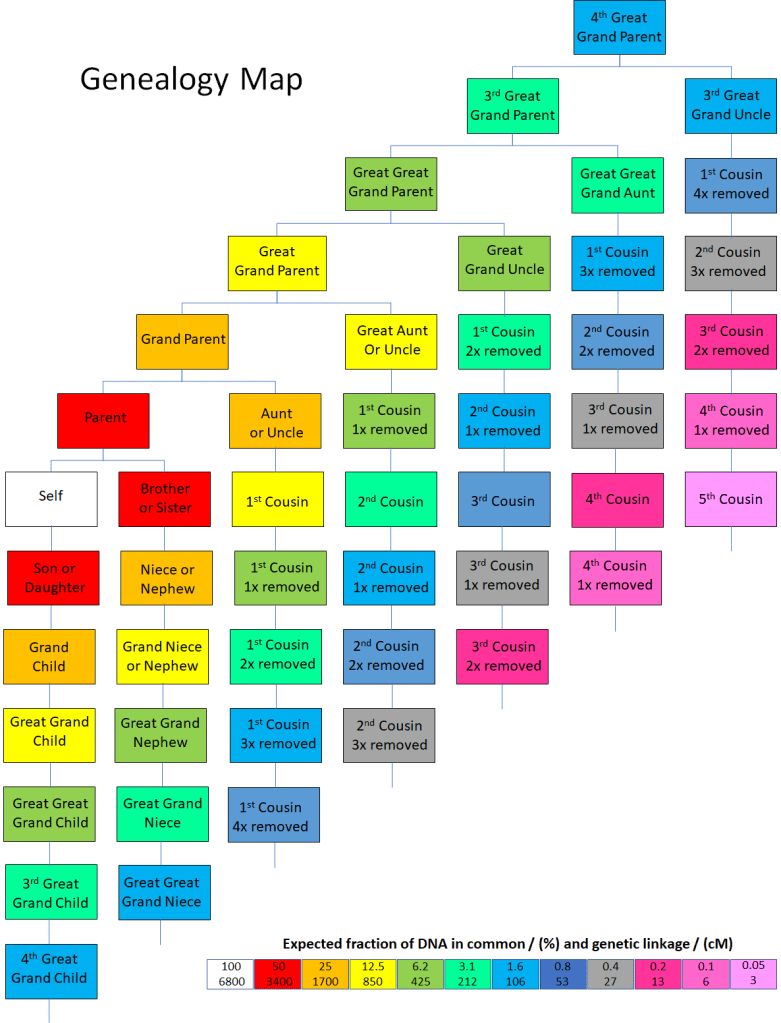
A human being has about 68 morgans (or 6800 cM, the genetic linkage between two individuals) that make up the person’s genes that are spread over 23 chromosome pairs. A centimorgan varies and has on average about a million base pairs that are in common. But a centimorgan unit takes into account the propensity to recombine in different chromosomes.
A similar diagram below gives the relationships including typical centimorgan ranges (99th percentile) found in studies. It also includes half sibling relationships.
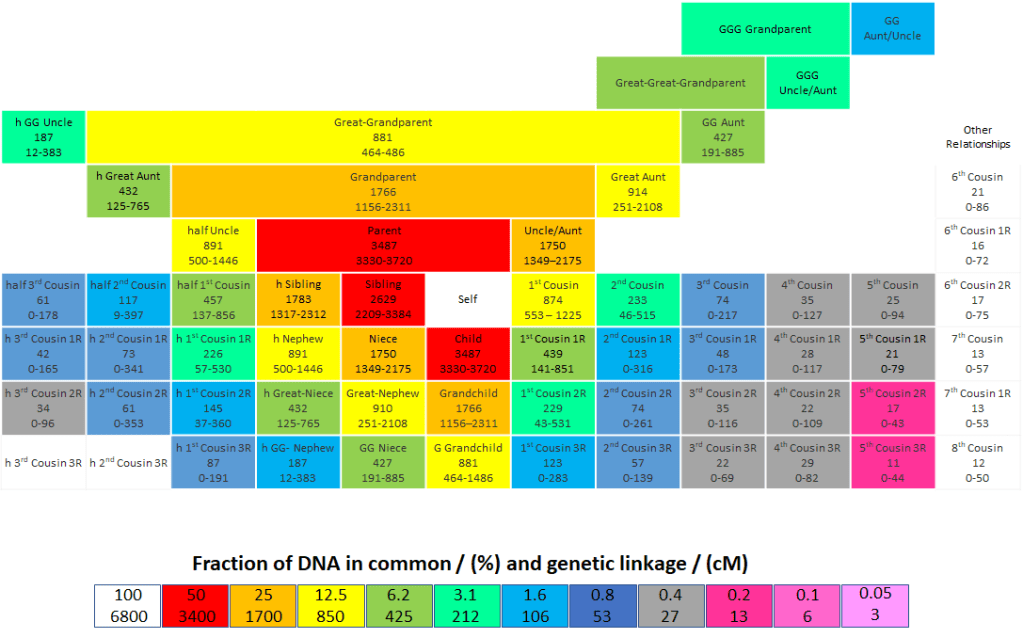
This is based on this link. There is something here I am not understanding, and that is why an identical twin would have only have a 3400 cM match? If a passing genealogist could answer that would be appreciated. The other thing that is clear the more distant relationships become less concrete when expressed as genetic linkages. Our relationships like the universe are a little chaotic.
The other bit of information that is provided is over how many segments our DNA is shared. An example is provided below. The numbers on the left are our chromosomes and the schematic shows where two first cousins once removed share DNA sequences.
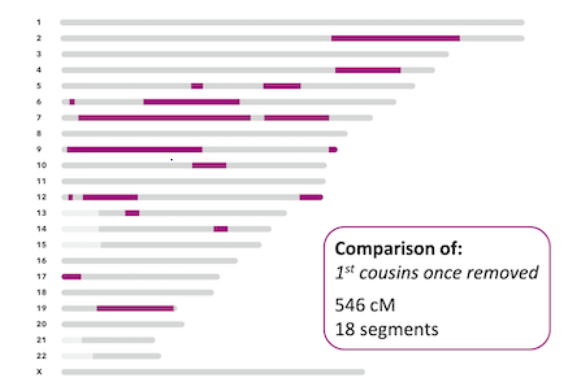
Not every chromosome has shared DNA and chromosomes themselves are not necessarily completely shared, though some might be closer to complete than others.
Family
Here is a picture with some of my relatives, some of whom met for the first time.

I’m in the blue denim shirt. This was taken a while ago.
Race
Some argue there is no such thing as race, in that two people from very different races might be more genetically similar than two people from the same race? And yet we can trace our immediate familial and ethnic ancestry using genetic techniques?
But one thing seems for sure: that our ancestors left Africa some 60,000 to 100,000 years ago and most have been roaming around since then. And before that, our ancestry gets a bit fishy.

 rom's corner