
Which authors have shaped my worldview? All of them, even if I have not read them, but some more than others. Having said that, not all of them are equal, and certainly not directly
In my preteen years, I recall avidly reading Enid Blyton’s Secret Seven and occasionally Famous Five. Generally, I let these books wash over me. At the age of eleven, I had a teacher Mr Harry Levine, who taught me that characters in written form could express themselves with intonation. AA Milne’s Winnie the Pooh was perhaps a little young for us, but Mr Levine made it worthwhile. The Incredible Adventures of Professor Branestawm was another in Harry’s repertoire. These books did not impact my worldview but taught me to enjoy reading.
While I am sure there were worldviews to be taken on in these books, the first book that had a message that I can recall was Jane Hope’s Scholarship at Stake. In a nutshell, it was a story about a parent’s odyssey to get her child to pass the notorious “11+ exam”. She went to a shop selling books and past exam papers, where she asked the proprietor the secret to his child’s success. The answer was that the child would get a new bicycle if he passed and a “hiding” if he failed (if I remember correctly). This was poignant for me, in that I failed the 11+, but luckily got a chance to take the 12+ and pass.
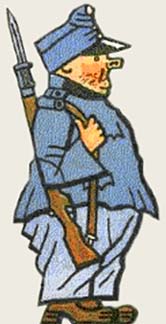
Josef Lada 1923
With my Dad’s encouragement, I read Orwell’s 1984 and Animal Farm, Erich Maria Remarque’s Three Comrades, A Night in Lisbon and of course All Quiet on the Western Front. Jaroslav Hašek’s The Fate of the Good Soldier Švejk During the World War. These suggestions were, I suppose, to shape my worldview. I must admit that in my youth, I was not a fan of socialism. However, that has abated a bit in my old age. Orwell’s 1984 left me with a deep suspicion that people can be manipulated by government and general ideas we can pick up along the way.
In my mid-teens and onwards, I started devouring science fiction. Asimov’s Foundation series, Heinlein, particularly Stranger in a Strange Land. But I can avoid saying “I grok” things, though. Ursula Leguin and my wife introduced me to Anne McCaffrey.
During this time, I also read: Stranger than Science, Chariots of the Gods and Worlds in Collision by Edwards, von Däniken and Velikovsky, respectively. While being attracted to such nonsense, the skeptic in me was stronger. And here I am talking fifty or more years ago, about my teenage years and my early twenties. I suppose these books were the only nonfiction I read other than school and university textbooks.
OK, I don’t want this to be a list of books I have read, and to be honest, the contents are mostly forgotten. But in my mid-twenties, I came across Douglas Adams and his Hitchhiker’s Guide to the Galaxy and the sequel, The Restaurant at the End of the Universe. I thought Adams and his books were brilliant. The books are short, easy reads. The language is immaculate … To boldly split infinitives that no man has split before. I remember in a movie theatre when that line was spoken, there was one lonely guffaw from the audience. The audience either did not get it or, like me, they had heard it many times already. The books are funny and almost sardonic.
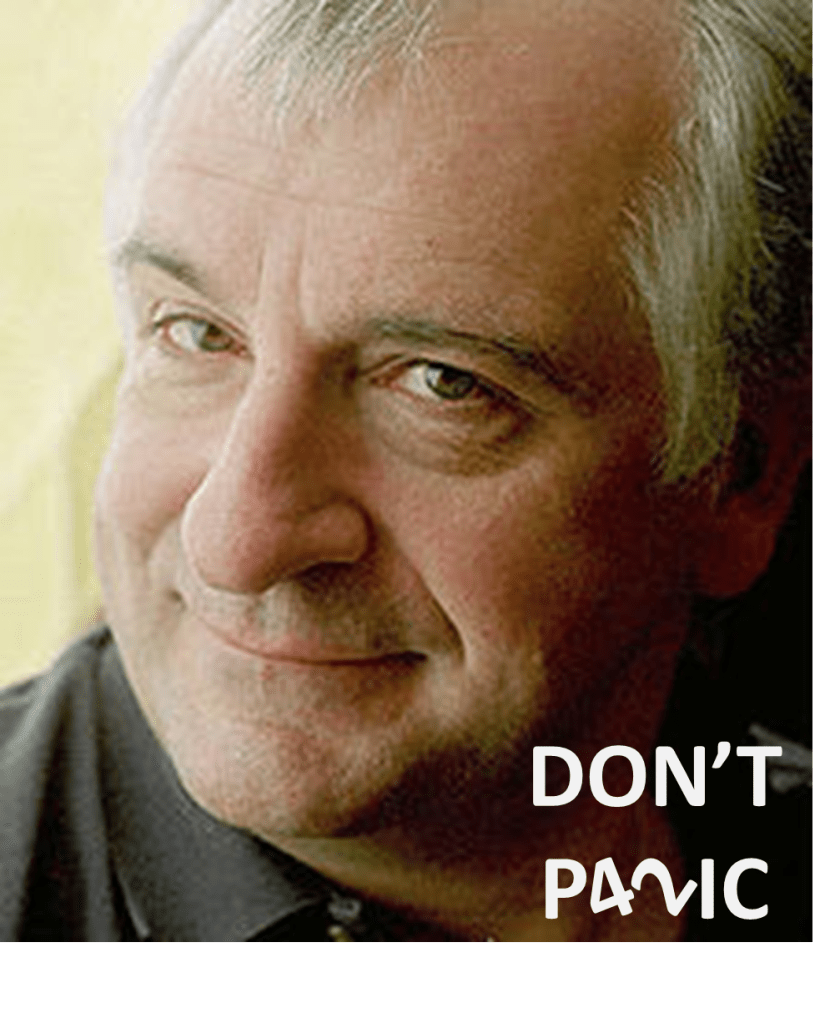
I read them as a transition between two worlds. I was just in the throes of finishing my PhD and moving to South Africa. When in South Africa, I reread the books a couple of times. Definitely a stranger in a strange land. With these books, I lost my vague deist outlook on reality. This book provided the comfort of humour in a strange new continent, familiar yet different. I reread them a couple of times when I came to Canada. Also, Adams seemed to be firmly an atheist, but he seemed “agnostic” about everything except god. This line captures the absurdity of certain forms of theism:
Isn’t it enough to see that a garden is beautiful without having to believe that there are fairies at the bottom of it too?
And he can lampoon philosophical types, I suppose, including me, quite accurately:
That’s right!” shouted Vroomfondel, “We demand rigidly defined areas of doubt and uncertainty!
The book shed light on the pointlessness and perhaps the pretentiousness of it all. Some pluralists scoff at science for promoting being devoid of meaning, yet literature and art can do the same. In All Quiet on the Western Front, the protagonist is killed just before the ceasefire is to come into effect.
I’ll skip over a few years here. I read mainly for pleasure and distraction. Christopher Moore, Lamb: The Gospel According to Biff, Christ’s Childhood Pal, is excellent. I thoroughly recommend the author. There were likely other authors and books I read, but none stick out at the moment.
Then, on 24th April 2007, things changed. Our son died. This was another wedge between me and meaning. What was the point of James’ painful existence? A friend lent me some videotapes of Joseph Campbell being interviewed by Bill Moyers in The Power of Myth. I would settle down on the couch to watch with a bottle of beer and fall asleep. Whether it was the scratchy tapes or what, I just could not “get into it”. My friend suggested A Hero with a Thousand Faces. Could not get past page 27. I got the drift, myths describe people’s journeys through adversity, and they seem to follow a pattern.

Called from comfort, the hero ventures into the unknown. Trials forge strength, mentors guide, and failure teaches. At the darkest hour, they rise, transformed. They return—not as they were, but as one who sees with clearer eyes. The world remains unchanged, yet everything is different. Their journey was never just out there, but always, also, within. ChatGPT-4o
I did not need a pedagogic tome to drive this home. I then came across a glossy, coffee-table transcript of The Power of Myth. I have read it three times, and it is due for a rereading. This discussion in print form captivated me in a way the scratchy videotape did not. Campbell appealed to my already agnostic worldview. Campbell was drawn to the Eastern traditions; he did not seem to have much time for our Abrahamic traditions. When I read The Power of Myth, I would add sticky notes to highlight a point that resonated, and when I reread the book, each time I would add more sticky notes, finding resonances that I had missed. Here’s an example on meaning:
People say that what we’re all seeking is a meaning for life. I don’t think that’s what we’re really seeking. I think what we’re seeking is an experience of being alive, so that our life experiences on the purely physical plane will have resonances within our own innermost being and reality, so that we actually feel the rapture of being alive.
Joseph Campbell and Bill Moyers, The Power of Myth, ed. Betty Sue Flowers (New York: Doubleday, 1988), 5.
I have read five or six of his books, I would recommend The Power of Myth, of course, Myths of Light and Pathways to Bliss. There are echoes of nihilism in Campbell’s worldview, but he does not embrace hard nihilism. He likes mysticism, I am not sure I agree, and I am not sure how much of the disagreement is purely semantic. I will leave you with one final Campbell quote that points to the “void”, again from The Power of Myth:
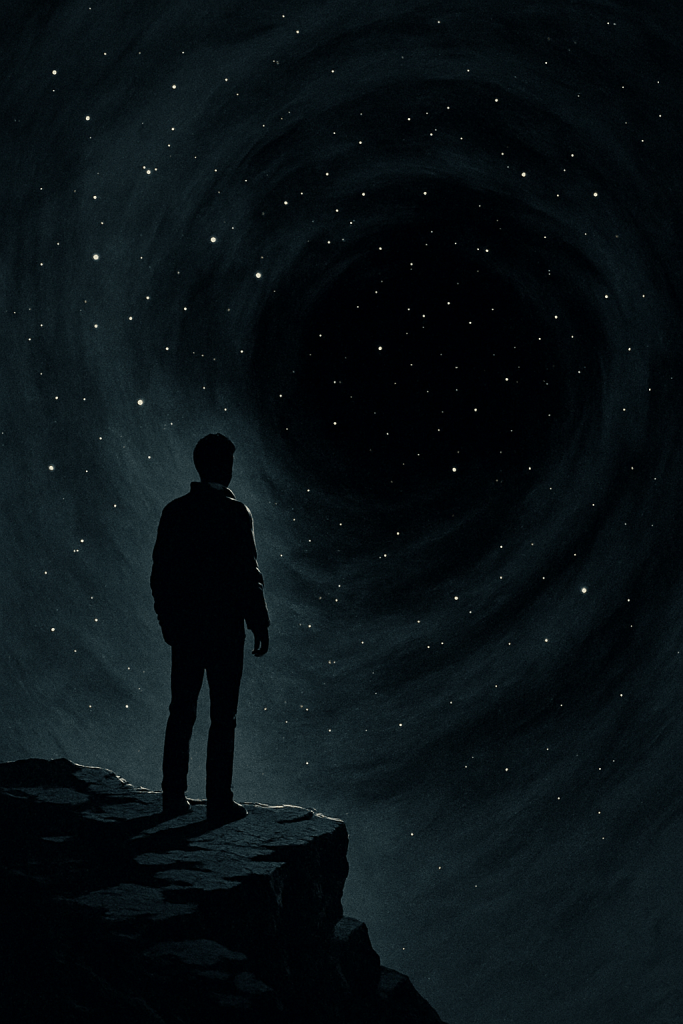
But the ultimate mystical goal is to be united with one’s god. … And with that, duality is transcended and forms disappear. There is nobody there, no god, no you. … Your mind, going past all concepts, has dissolved in identification with the ground of your own being, because that to which the metaphorical image of your god refers is the ultimate mystery of your own being, which is the mystery of the being of the world as well. And so this is it.
Since my Campbell era, the books I have read have been mostly where science and philosophy meet. Free will is a major genre; Steven Pinker would be the most repeated author, followed by Dawkins and Dennett. Physics and cosmology play a major role in the collection, as they do have some bearing on our travels through our life experiences.
I have highlighted two authors, both rejecting God, one more completely than the other. Both look into the meaningless void, one with humour and absurdity, the other with awe. I think each might be one with much of their worldviews. I suspect Campbell would have more sympathy for Adams than the other way round. They played pivotal roles in the transitions of my life. Of course, other authors have influenced these authors, eg, Jung influenced Campbell and Dawkins, Adams. Life events have influenced these authors, as has the experience of life influenced me.

 rom's corner