
People have a strange capability of believing weird things. Some examples:
- The world is flat
- The moon landings were fake
- Vaccines are harmful and microchips
- The Earth is only six to ten thousand years old
- Donald Trump was worth voting for a second time
- Angels and jinns
- Karma and reincarnation
- Afterlife
- Divine Birth of Jesus
- Mings was never a good centre-back
- Mohammed splitting the moon in two
- Evolution is somehow not testable and has not been observed
- Biological sex is a spectrum.
While looking for data on flat Earth beliefs, I came across a study by the University of New Hampshire that is a little worrisome. It also had some data on four other aspects of belief that I will touch on, so I had to reorder my list. This post turned out to be much longer than I expected. There are many more strange beliefs that I could have added. In no particular order:

Flat Earth
Of all the strange beliefs people have, this is probably one of the strangest. When I saw the meme to the left, I was more than a little skeptical. One in ten? Really? Despite the mountain of evidence for an oblate spheroid, believers conjure up weird theories and poor observational skills to back up their beliefs. Educated people have believed the Earth is spherical for over 2500 years. Earth’s shadow on the moon was a clue. Eratosthenes even determined the size of the Earth surprisingly accurately back then in 240 BCE.
Flat Earthers have to believe that gravity does not exist, the Cavendish experiment is a hoax, and space stations are fake. Or at least so Flat Earthers contend. They develop convoluted theories that try to explain the spherical Earth. Their science is shoddy. One theory is that our flat Earth disc is accelerating. An upshot of this is that, at an acceleration of 9.81 m/s2, the Earth will be travelling at the speed of light after one year, ignoring relativistic effects. If we accept relativistic effects, then satellites and GPS may have a point. There has to be a huge conspiracy perpetuating the myth of a spherical Earth: governments, space agencies, airlines, and pilots.
Moon Landings Faked
This, of course, is closely related to the flat Earth belief. I have some sympathy for this. I can remember watching on the television, Armstrong taking his one small step for a man and turning to my Gran, who was watching with complete disbelief. But then she was born in what was then rural Russia at the very beginning of the 20th century.
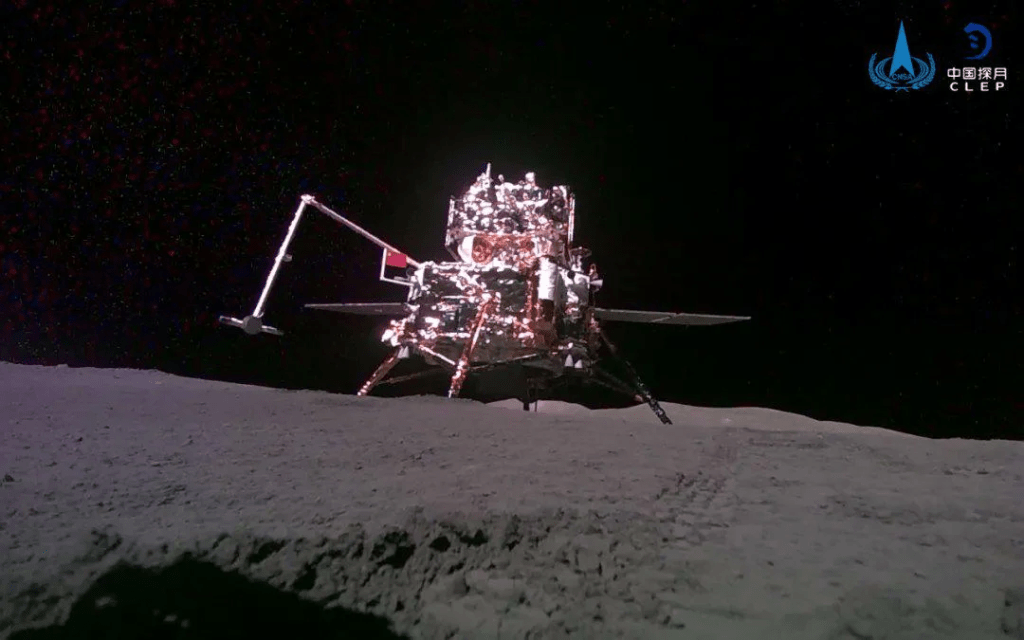
While what the Apollo mission did in the sixties is amazing by today’s standards, the hoops people will jump through to deny this achievement is also amazing. It is not just the early Apollo mission they are denying, but all the other, less grand achievements. India and Japan’s landings, China’s return of 1.73 kg of lunar soil, not to mention roving about on the far side, the Soviet Luna program that returned samples three times for a total of 0.326 kg, and of course, the Apollo program that returned a total of 382 kg, not to mention its astronauts. And by the way, the moon too is spherical; the far side is not a disc.
Any evidence that can be brought to bear for an oblate spheroid is declared fake.
Vaccines and microchips
This nonsense came to prominence recently during the COVID-19 outbreak. Now I have my doubts about me wearing a mask protecting me from the flu, but I have little doubt that my wearing a mask will protect others, to some extent, from me spreading the flu. In either case, my position won’t be 100 % accurate. With the flu, we are contagious for about a day before we have symptoms. Interestingly, for COVID-19, it looks like this period of contagion before symptoms show lasts 2 to 3 days. So, as a thought experiment, should your dentist wear a mask during your procedure, to protect you, her, or both? Below is the data for COVID hospitalizations for Canada, the US, and the UK.
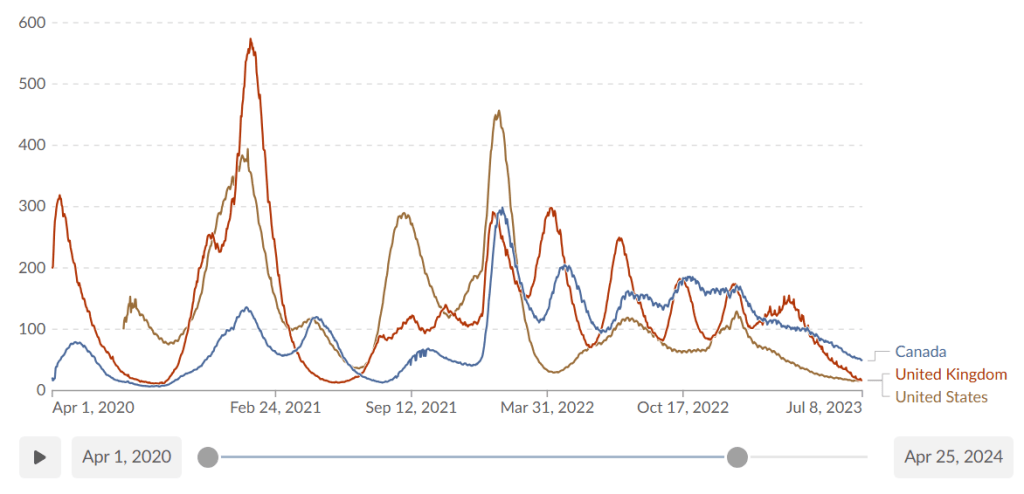
The COVID hospitalizations give an indication of the stress put on our health systems. Data for the reported COVID deaths is likely to be underreported, and the excess deaths, while likely a better measure, will have confounding effects like reduced traffic deaths. The COVID vaccines started to get rolled out in earnest at the end of the first quarter in 2021, primarily to the most vulnerable and the elderly.

In my lifetime, one abhorrent human contagious disease has been eliminated. Smallpox. This virus could cause deaths as high as one in three in unimmunized populations. In virgin aboriginal communities, as high as 50 to 90 %. Survivors could get serious scarring, especially of the face. The story of cow pox being a surrogate for immunization is well known, but people have been immunizing for smallpox in China for perhaps a thousand years.
The last known new case of smallpox was in 1977, and the last death from smallpox was in England in 1978. Smallpox was officially declared eradicated in 1980. The eradication effort after a false start or two took ten years to be successful.
Currently, the effort to eradicate polio has been ongoing for fifty years or more. Rotary kicked off its program to eradicate Polio in 1985; a Rotary program to immunize every child in the Philippines started earlier in 1979. They were a founding member of the Global Polio Eradication Initiative in 1988. The Bill and Melinda Gates Foundation has donated nearly five billion dollars to polio eradication. Polio types 2 and 3 have been eradicated. Type 1 is still endemic in Afghanistan and Pakistan.
Of course, there are other vaccine controversies, the measles, mumps, and rubella vaccine, the mercury-based preservatives, and, it goes without saying, microchips.
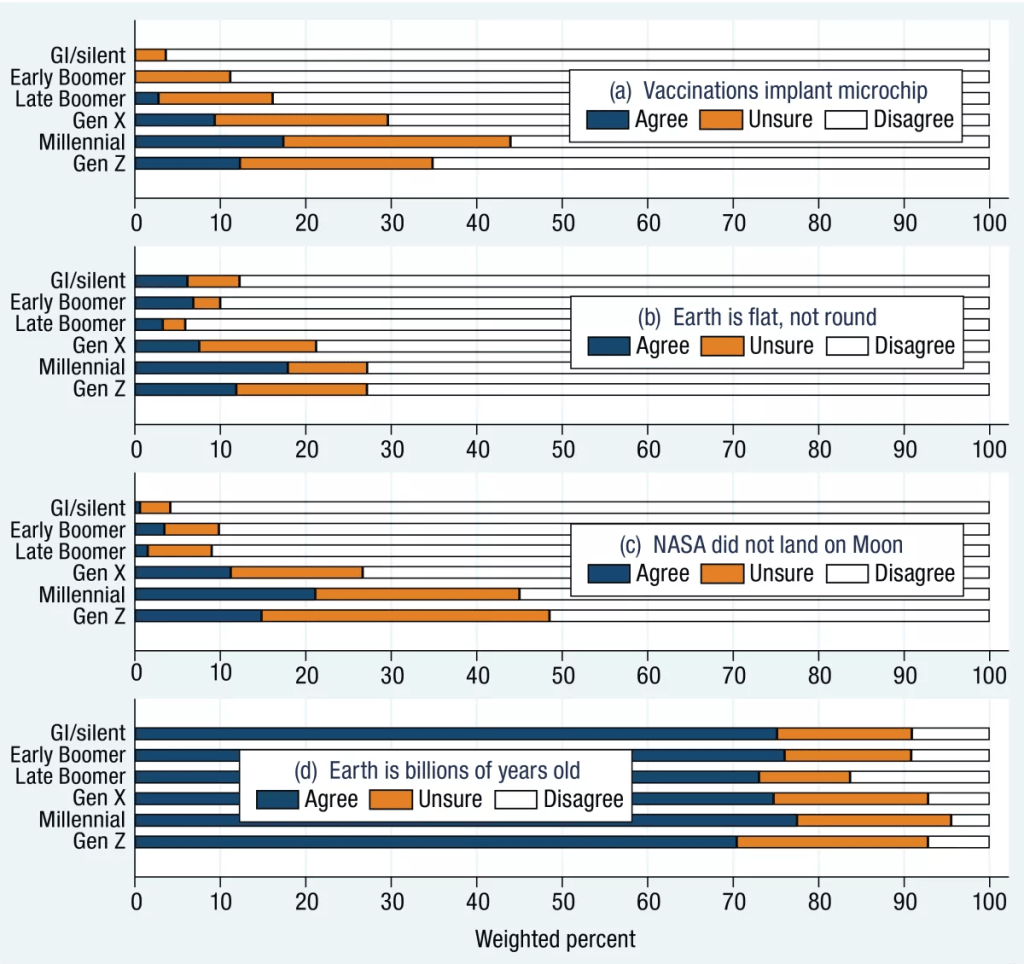
The New Hampshire study is disturbing in that it tends to be younger people who are unsure or perhaps buying into these strange beliefs. The good news is, I suppose, a young Earth seems to be purely a religious aberration, and young people as a whole have not bought into it. The study also notes that people with a conservative outlook tend to be more susceptible to conspiracy-like theories.
The Earth is only six to ten thousand years old
The figure also shows that the belief in the age of the Earth is more or less independent of the age of the believer. Though late boomers like me tend to have a higher probability of believing in a young Earth. Having said that, amongst evangelical Christians, young Earth creationism is rampant. I suppose not surprisingly, the study also showed that people who approved of President Trump in his first term were more likely to think or were unsure about an ‘old’ Earth.
Donald Trump was worth voting for a second time
Well, Donald Trump’s first term did not inspire me with confidence. His second term is a bit of a mess so far, at least by my reckoning. Having said that, I don’t disagree with what he is trying to do. There is nothing wrong, in my opinion, in:
- Creating conditions to encourage manufacturing to return to the States.
- Getting fair trade deals with partners and foreign countries.
- Having a healthy and stable economy.
- Reducing wasteful government spending.
- Having secure borders and limiting illegal immigration.
- Returning illegal immigrants to their home countries.
- Reining back in some of the DEI excesses carried out under the Democrats’ watch.
- Encouraging allies to live up to the defence spending commitments.
- Wanting to help end conflict in Ukraine and Gaza.
The problem is not what he wants to achieve, but the way he is going about it. Trading partners and military allies will no longer trust the US. The US has always had isolationist tendencies, but under Trump, they have been exacerbated. The way Zelenskyy was treated in the Whitehouse will give pause to future potential allies.

Mings was never a good centre-back
I play on a Villa football forum. On that forum, there are a whole bunch of opinions on various players. Quite often, it is that they are not good enough. I think he has, in the past, had more than his fair share of abuse. Now, like most players, he has had his share of mistakes, and as a defender, his mistakes have led to opponents scoring. A recent howler was him picking up the ball when the goalkeeper had passed the ball to him from a goalkick. Having said that, he had just come back from an ACL injury that took a year to repair and heal. His defensive stats are good: he wins an exceptionally high percentage of aerial duels. Mings ranks highly for blocks, shot‑stopping, and preventing dribbles past him. His error rate leading directly to goals is low relative to his playing time.ChatGPT He is good at marshalling the backline, he is an enforcer, saving his team-mates from getting into a fight. When he had his captaincy removed (unnecessarily in my opinion), he handled it completely professionally. He still plays the captain’s role without the armband.

Karma and reincarnation
The problem with karma for me is that I don’t see it. Have the likes of Bezos, Musk, Zuckerberg, Buffet, and Gates done something that somehow deserved a hundred billion or more? I get that Bill and Warren, now that they are getting near the end, are redistributing their wealth to worthwhile causes. But then some wonderful people have all sorts of trials set upon them. This karma thing, if it exists, seems to be dished out chaotically to me.
And for me, reincarnation seems a bit of a stretch. Coming back as a grasshopper only to be run over by a truck seems a bit unfair to the grasshopper. I am reminded of Douglas Adams’ Agrajag here, a character that keeps being reincarnated only to have his life ended by Arthur Dent.
Afterlife
While technically I am agnostic about this one, I am also extremely dubious. From a scientific point of view, it is true that energy cannot be destroyed, but energy is being ‘degraded’ all the time while it is used. So, what is topping it up after my death? Or is my afterlife being continually ‘degraded’ also? As for consciousness surviving death, my best argument against it is diisopropylphenol with a hint of fentanyl. Where did my consciousness go when I was in a deep anesthetic sleep?
It is argued that people have a psychological need for an afterlife with the loss of a loved one or perhaps for the love of their own life. I don’t really buy it. Around me, most of the belief seems to come from religious patterning. ie I live in a largely Christian community.
Angels and jinns
In the US, the belief in angels is surprisingly high. A 2008 Baylor study found more than half of the adults surveyed believed they had been protected by an angel. This is highlighted by survivors of serious accidents. People ask themselves why they survived when so many others died.
Whereas belief in jinns or genies is practically non-existent outside of Muslim communities, belief in jinns can be quite high in Muslim countries. A Pew survey in 2012 found that over 70 % surveyed believed in jinn in Malaysia, Bangladesh, Pakistan, Afghanistan, Morocco, Tunisia, and Lebanon. Now, the perception of what jinn are for Muslims will be different from the typical Western caricature of a genie.
Divine Birth of Jesus
This is likely one of the most widespread of weird beliefs. There are two broad flavours, one Christian and one Islamic.
In the Christian tradition, an angel came to a young girl named Maryam (or an Aramaic equivalent) and foretold of a divine birth. Despite the two gospels disagreeing on the details, the other two gospels are completely silent on this foundational event. Depending on the apologist we listen to, Maryam may or may not have been a virgin. Nevertheless, Jesus is the son of God in the Christian tradition. He goes on to do a lot of miracles.
In the Islamic tradition, Maryam, a virgin, is chosen and purified by God. An angel, usually understood to be Gabriel, announces to her that she will bear a son decreed by God. She goes to a remote place and experiences a miraculous conception. When she returns with the baby, her people accuse her of wrongdoing. The infant Jesus speaks from the cradle, declaring he is a servant of God, a prophet, and that God has blessed him.
If I claimed a young girl down the road said she had an angel come to her and foretold of some kind of divine intervention and birth, how many people would believe her?
Mohammed splitting the moon in two
I don’t want to spend too much time on this one. I suspect the majority of Muslims believe in this miracle. Could not find the data, but most Muslims seem to follow traditional interpretations of the Qur’an. This, of course, is nonsense, at least from a secular or educated point of view. Some Muslims ascribe this to a metaphor or somehow as symbolic language. There is a scholarly debate amongst Muslims. The literalist argument is simple. God created the universe; splitting the moon will be no problem. People ask how other cultures did not see this, no problem, God hid it from them?
All this stems from the belief in the inerrancy of the Qur’an.

Evolution is somehow not testable and has not been observed
If we have a system that:
Replicates
With variation
With environmental selection
Then evolution becomes a logical necessity. Of course, the variation has to be small and over a long time for macroevolution. These small changes accumulate over time and become evident in the phenotype, resulting in speciation and ultimately: genus, family, order, class, phylum, and kingdom. Some people are comfortable and accept microevolution. Here’s an excellent example of microevolution and a warning about antibiotic resistance. All in under two weeks.
Evidence for evolution? For me, the strongest is basically the DNA analysis of life. Dawkins’ concept of (Genetic) Book of the Dead is brilliant. We can see how and how distantly we are related to the rest of creation. Of course, the fossil record shows simple transitions in how a wolf-like animal’s ear (Pakicetus) adapted to a marine environment. Another example is where paleontologists were arguing about whether fossil Therapsids from the Powder River Basin were mammal-like reptiles or the other way round. Vestigial structures are another example, where a branch of the vagus nerve, which goes from the larynx to an artery near the heart and back to the brain. From a design point of view makes some sense in a fish, less sense for humans, and absolutely none in giraffes. This becomes understandable through the lens of evolution.
Biological sex is a spectrum
Is biological sex a spectrum? I would say no, but it does depend to some extent on what the definition of biological sex is. I tend to go by gamete size or at least whether we have the evolutionary blueprint (not necessarily working) to produce large or small gametes, female or male. This discussion is primarily about human beings, which again seems to me to point to some kind of anthropic exceptionalism.

Anyway, the 1.7 % of people we often see quoted falling somewhere on the spectrum comes from a paper by Anne Fausto-Sterling in 2000. She later walked back her number to 0.018 %. This number only includes births with genital or gonadal ambiguity. Effectively binary. If in biology we hold evolution supreme, then it might be wise to have our definition of biological sex that coheres with evolution.
This, of course, says nothing about how we might treat people with genetic anomalies, different brain chemistries and structures. And perhaps have been habituated by their environment.
Why?
What would cause otherwise reasonable people to believe in such weird ideas? A couple of artificial intelligence systems suggested several possibilities, in italics, and I have included some commentary.
- Confirmation Bias: While it is true that people tend to favour information that confirms their existing beliefs, this would be an effect of continuing having an outlandish belief rather than a cause.
- Cognitive Dissonance: On its own, cognitive dissonance would lead to dissuading people from unusual beliefs. The discomfort of holding conflicting beliefs can be reduced by rationalizing or dismissing contradictory evidence, leading to belief persistence.
- Causal Thinking: People naturally seek explanations for events, and initial explanations can be difficult to dislodge even if incorrect. Seeking explanations is perfectly reasonable.
- Pattern Seeking: The human mind has evolved to find patterns, connections, and to model reality; these can sometimes lead to erroneous conclusions. Taken together with confirmation bias, ie, noticing correlations rather than non-correlations.
- Personal Identity: Having a special belief might set one apart and make oneself feel unique. Personally, I don’t get it, but I suppose it might work for someone.
Need for Belonging: Conformity is almost the opposite of personal identity. Being in a group that shares a belief can provide a sense of community and identity. - Need for Control: This points to believing in things like the power of prayer, lucky charms, picking a lucky number, and maybe astrology.
- Emotional Investment: This seems in part to be a blend of identity; to some extent, I am what I believe. It also may include: a sunk cost fallacy, especially for social capital spent.
- Social Influence: I noticed, personally, after seven years in a very secular environment, my exposure to religious and conspiracy-type beliefs was negligible. In my environment they were discouraged. Either way, our beliefs in part are forged by the environment we grow up in or by the one we find ourselves in.
- Emotional Exhaustion: I think I understand this one. After James had died, I was emotionally drained and susceptible to new ideas and beliefs. It was at this time that I lost my belief in free will. This is one of the pillars in Joseph Campbell’s A Hero’s Journey.
- Compelling Narratives: This might be true for me? After seventy years of experience, I might not be ready to override the programming that I tell myself has worked for me.
- Magical Thinking: This might include a belief in a universe that has meaning beyond any meaning we might impose on it. Some kind of morality exists beyond human conception of it. Never mind Gods that split moons in two.
- Lack of Information or Critical Thinking Skills: I don’t think people have a lack of information. Almost the opposite. One can find a mode thinking that will fit whatever preconceived ideas we might have. What we might lack is the education and energy to test out our thinking skills.
- Do I have any strange beliefs?: Yes, quite possibly. Though more often than not, they turn up in agnostic form, a lack of belief. These might be considered strange:
- A lack of belief in free will. This is a result of a belief in cause and effect.
- A rejection of Naïve Realism. An example is that objects themselves don’t have colour.
- Things like human rights, justice, morality, and deserving are useful fictions. Of course, these things exist as concepts and perhaps as evolutionary ‘senses’, but in reality, they are no more than useful rules of thumb.
Like everyone else, I generally manage to bumble along with my ‘strange’ beliefs.
And in the End
‘Isn’t it enough to see that a garden is beautiful without having to believe that there are fairies at the bottom of it too?’ Douglas Adams
And to prove the point, a view from the back of our house. Note the garden shed for the fairies.


 rom's corner