
Recently, a whole bunch of flat Earth-type videos have appeared in my YouTube suggestions. But it is an interesting question. Just ignoring the massive acceptance of the Earth being an oblate spheroid. Ignoring the millennia of people measuring the Earth’s radius, engineers accounting for the Earth’s curvature for large projects, ie, long tunnels and bridges, air travel, and pictures from space. In the flat Earth world, all these are simply dismissed as a conspiracy.
But it did get me thinking about what personal evidence I have for a spherical Earth. Well, not much to be fair. Things that come to mind are: the curved shadow of the Earth on the moon during lunar eclipses. Ships and the bottoms of buildings disappear when beyond the horizon. And when flying high, the Earth does appear to be curved.

Speaking of flying I have had the opportunity to fly across Australia, from Sydney to Perth and back. Australia is not as big as the Gleason map by Trekky623 makes out. And what about magnetic north and south? The magnetic south pole is more or less directly south of Adelaide, just off the coast of Antarctica.


And this brings me to the purpose of this post. I have mentioned before, the Cavendish experiment that can measure the universal gravitational constant. Flat Earth proponents have to deny gravity in some sense, in that gravity would not be straight down on a flat Earth. And the Cavendish experiment is simply a refutation of the claim that gravity does not exist. Cavendish’s setup was developed by Jon Michell, apparently a brilliant natural philosopher who has had little recognition in the scientific history books. Michell died and his equipment eventually passed to Cavendish, who carried out the experiment in Clapham, London, from 1797 to 1798. My wife is from Clapham, so this is a natural for me.
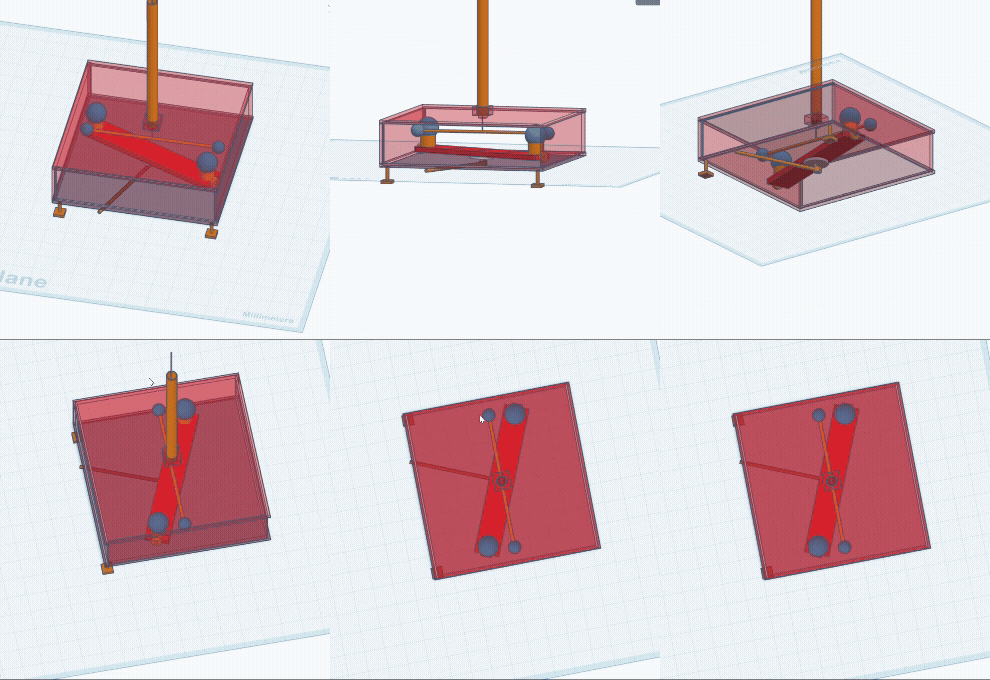
I looked for a convincing video of the experiment, but I could not find one. Though this one is not bad, Steve Moulds’ video shows how difficult it is to do it at home, and also demonstrates an off-the-shelf apparatus that is used in colleges. Anyway, I’m planning to build and repeat the at home. The picture to the right is roughly the setup I am aiming for. Glass windows will enclose two of the sides of the equipment to minimize drafts. Currently, the plan is to use lead balls; the heavy ones are about 5 kg, though there may be room for 6 kg each. The suspended balls are about 1 kg each. The footprint is about 80 cm by 80 cm, and the length of the pipe is about 90 cm. All this is subject to change.
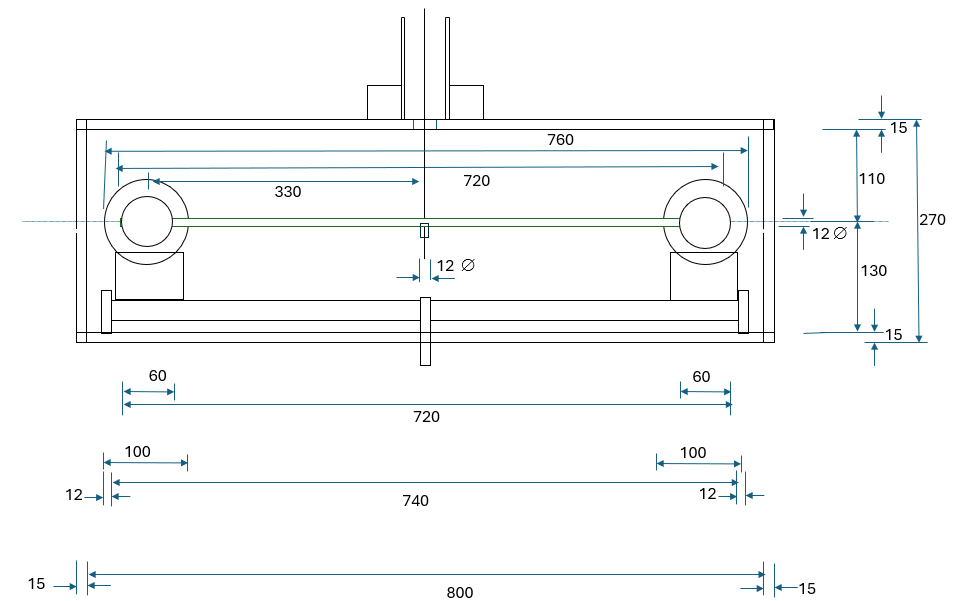
Below are two sketches of the anticipated dimensions (mm). The enclosure will be made from 15 mm plywood, and the pipe for the wire will be about 50 mm in diameter and covered, again to minimize drafts. Initially, the wire for suspending the rod is anticipated to be 1 mm nylon monofilament fishing line.

There is no downside to having larger masses for the heavy balls other than weight considerations. Having heavier small masses is more of a weight consideration, and it will increase the period for the oscillation, but it will also increase the deflection (θ) and make it easier to measure.
A heavier gauge line will decrease the period of oscillation and decrease the deflection, but will be less susceptible to stretching and changing its torsion constant. Ultimately, there may be a benefit to going to a tungsten or phosphor bronze wire.
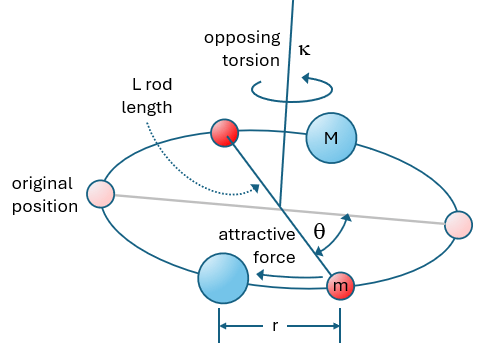
Anyway, to determine Newton’s universal gravitation constant, G, a modicum of maths is required:

Where m is the small mass, M is the large mass, L is the length of the rod (distance between the centre of gravity been the small masses), θ is the angle the pendulum deflects, T is the period of the pendulum, and r is the distance between the centre of gravity of the large and small masses at a given stable deflection.
Most of the materials have been sourced. The tricky bit will be getting hold of 15 kg of pureish lead at a reasonable cost. I really want to avoid recovering the lead from 60kg of wheel weights.
I will try and document the build and experiment in separate posts.

 rom's corner