
I struggle with the concept of ontology. So, I am having a crack at it. Having said that, I am not sure that I believe in metaphysics1. But moving on:
- the branch of metaphysics dealing with the nature of being.
- a set of concepts and categories in a subject area or domain that shows their properties and the relations between them.
I am immediately reminded with the first definition of my English teacher, Mr Grainger, that the word nature is completely superfluous. So what do we mean by ‘being’? We’ll come to that later. For the second definition, it seems we could, if we wished, apply a healthy dose of the scientific method. The use of the word ontology started increasing in the 1940s, revived by WVO Quine; with the beginning of a very sharp rise in 1990 and peaking in 2012 (no data after 2019). The sharp rise was because AI researchers borrowed the term for their use.
Of course, different philosophers can have different takes on what they mean by being. For now, I will take it as synonymous with existence or perhaps reality. I will ignore antirealists, in that their position is a little self-refuting, but they, too, can have an ontology. They deny a mind-independent structure of reality. Aristotle thought of being as substance, ie what something is, or perhaps property, relation, potentiality and actuality. Medieval use, being: something that is common to everything that exists. And Heidegger’s take, which I will probably spend most time on: Being (note the uppercase), which makes entities intelligible as entities. As opposed to beings which are simply entities. Apparently, philosophers keep this abstract; I might call it obtuse.
Going back to ontology, “relation[ship] between something and a difference it makes,” I thought could in part be ontology in a nutshell, ie reality is relational and differential, and not substance-based.
I thought Heidegger’s distinction between Being and beings was interesting. Though I will drop the uppercase B and replace it with the lowercase. For Heidegger, beings are entities and being is an overarching context, eg:
- characters and novels
- actors and movies
- gods and myths
- archetypal characters and emotions
- symbol and concept
When I first read of Heidegger’s distinction between being and beings, I could not help but think of cosmos/universe and everything else. Now, of course, this is very easy to interpret as: I’m thinking of a very big entity, which can be divvied up into a whole bunch of smaller ones like galaxy clusters, planets, mice, atoms, fields. I think this response is understandable. But, to clarify, with my response, my universe is more of a monist’s worldview. I see cause and effect as true. Exceptions to cause and effect might include:
- If real random events occur. Random in the vernacular often means chaotic or philosophically epistemic ignorance. I am deeply suspicious of the concept of random.
- Somehow, cause and effect are fragmented, but then I suspect this would reduce to random or perhaps a whole bunch of ‘first causes’ like random is equivalent to.
- If the block universe is true in some sense.
If the process of cause and effect is true, then a monistic worldview seems to me inevitable. Whether this leads back to a singularity or an infinity is irrelevant. If someone has a different take, I am interested.
The separation of being and beings feels like a bait and switch. Are beings independent of being in some way? So if we carefully apply the scientific method to beings, will we not gain some insight into our underlying reality?
The universe unfolding is the being. Now, of course, grammatical rules force us to think of the universe as a noun. Whereas it could quite reasonably be thought of as a verb. Generally, the more complex an entity, the more verb-like it is. An exemplar is a tree. Is this tree a noun? Grammatically yes. In practice, less so. A tree has a multitude of processes in action; it is doing stuff. Growth, fertilization, reproduction, photosynthesis, osmosis, biochemistry, quantum phenomena, diffusion, transpiration, aspiration, redox chemistry, evolution, translocation, gas absorption, and release. I could go on. When we say tree, do we include the associated biome? I might be accused of reductionism here. But I am not denying top-down causation. While I am skeptical of quantum theories, I am willing to accept, for argument’s sake, that the wavefunction of the universe is what determines the probability of a quantum event. This can hardly be described as top-down reductionism.
Heidegger thinks modern science quietly forgets the distinction between being and beings, studying particles, fields, and organisms. While I think it is true that science is primarily ontic, the question I would have for Heidegger is whether there is absolutely no overlap between ontic and ontological. The study of chemistry bolsters the understanding of what makes beings or organisms possible. While the study of chemistry might not provide an ultimate answer, it is certainly stepping closer to an ontological answer. While Heidegger might be right in that ‘science’ presupposes an ontological framework, the ontic study is continually reshaping that framework.
The claim I am making (ultimately) answers the question of what is the best way to ascertain reality and how we likely will not get there completely. I see ontology as “what survives disciplined inquiry“.
And finally, the scientific (ontic) process can peer back in time, the microwave background radiation, or the picture from the James Webb telescope showing galaxies galore, and the lensing of light at a surprisingly early formation in time. The light from the lensed galaxies has travelled over 13 billion light-years.
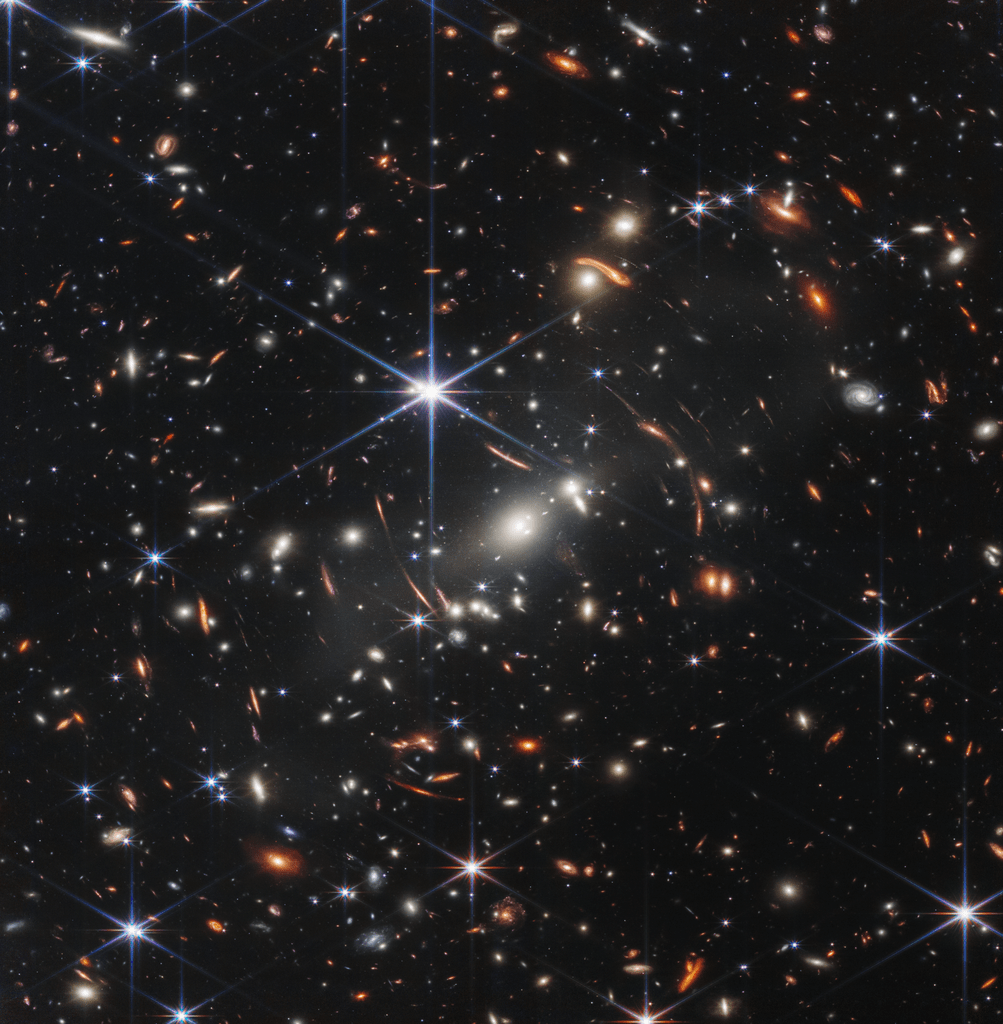
NASA, ESA, CSA, STScI
I have been struggling with this post for weeks now. Time to let go. It is a bit of a mess. So it goes. If this is only ontic science, and Heidegger and others cannot find ontological meaning in this, so be it. If I had the skills, I would be willing to give it a go.
Turtles all the way down? Bah!
Ontic all the way down!
1 In metaphysics philosophers ponder allegedly unanswerable questions. Does god exist? Questions pertaining to existence. Life after death, anyone? Now I am not suggesting we can’t sit in an armchair and ponder these tricky questions. What I do object to is that these questions can’t be answered. We can look for Sagan’s invisible dragon, but we will rule out properties of the dragon, one by one. This is the power of ontic exploration, versus, the speculation of Sagan’s dragon.

 rom's corner