
I started reading How to Change Your Mind by Michael Pollan. I have not got very far into the book, but it is about using entheogens (psychoactive drugs) in some way to activate one’s spiritual mind. I quickly skimmed through the book and it did not have a single chemical structure in it. And being a chemist by trade I was a little disappointed. Officially I’m turning a pensioner this year, and with that comes medications; I always look up the chemical structures of the medications to get a sense of how well these medications will bind with metals. Well I suppose that is just me. So, this is a brief review of the chemicals that have shaped my life … well a little bit tongue in cheek.
Back in 1974, at university we were given a choice of several topics for a practical that would last a term (semester). The topic of solvent extraction stood out, I had a friend who just finished his PhD in solvent extraction, and being a fairly lazy student, I thought this could be an easy in. Well it turned out it was not.

My friend’s PhD was about the extraction of cobalt and nickel from ammoniacal solution using Versatic acid into a kerosene phase. In actual fact the Versatic acid is a mixture of carboxylic acids that have various of tertiary alkyl groups attached, whose average chain length is about ten. A couple examples are shown to the left. The business end of the molecules is double bonded oxygen and the alcohol attached to a carbon in the middle (carboxylate). The hydrogen of the carboxylate is labile and can swap places with a metal ion releasing a proton. All this was a little complicated for one term.
Anyway, I carried on with the solvent extraction project seeing if we could separate cadmium from lead in solution, using 8 hydroxyquinoline, shown below.

The short answer is yes, but no one in his right mind would use this. But it was an interesting project for me in that the hydroxyquinoline is partially soluble in water and that had to be taken into account when modelling the system. Earlier in my studies, I had an unfortunate alcohol-induced incident in a computing seminar (well it was my twentieth birthday) so I was keen to do well on the computing side of things. This has stood me well in my career as simple modelling has been a staple of my professional life. Anyway, the practical project finished, and it was thoroughly enjoyable.
In my final year at UEA we had a course called Metals in Biochemistry, in some ways it was not a very academic course, but I found it really interesting and I could see the connection of “natural” chemicals with the synthetic chemicals that chemists, engineers use in solvent extraction. A couple of examples:
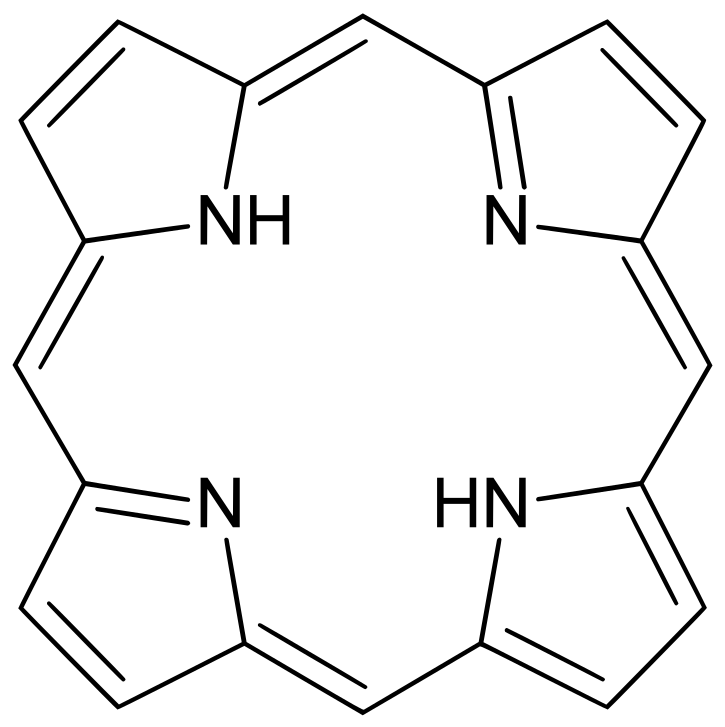
Porphine, although not found in nature, is the business end of an evolutionary technology. This porphine is the parent structure of the porphyrins, important building blocks found in nature.
I was taught at university that thermodynamically six membered rings (followed by five and seven) were the most stable. This sixteen (or twenty) membered ring (albeit also containing four five-membered rings is found all over evolution). The structure can be considered aromatic, ie the double bonds can be considered delocalized. While no doubt many metals can be bound to the center of the ring, principally four metals can be found at the center of different porphyrins: for example, cobalt is at the center of the porphyrin found in the vitamin B12 and nickel in Cofactor430 in archaea.
From a life as we know it point of view chlorophyll has to be considered one of the most precious porphyrin chemicals. The chlorophyll shown below is one of various versions, But all have magnesium as the central ion.

This chemical, sunlight, and water is the pretty much the source of the molecular oxygen we breath. I was surprised it is the water that is the source of the oxygen and not carbon dioxide. The reduced hydrogen (or hydrogen ions and electrons) is then used to reduce the incoming carbon dioxide to store the carbon as sugars. We can split water into oxygen electrolytically. Scientists have been also taking a page out of nature’s book and using a copper-based porphyrin to make oxygen from water and sunlight.
The other great evolutionary porphyrin invention is heme (or haem). Again, there is more than one heme.

structure of Fe-porphyrin subunit of heme B.
Notice with iron in the centre of the porphyrin ring, the structure becomes a collection of six and five membered rings. Similarly, with chlorophyll and magnesium.
A little while after I finished my chemistry degree, I had the opportunity to do a PhD at the University of Birmingham. Funnily enough it was my solvent extraction friend who suggested I contact his PhD supervisor, which I did. Two weeks after saying no, the supervisor phoned and asked when I could start. With this, my career in the mining industry was cemented.

2-hydroxy-5-nonylacetophenone oxime
I had a fun three and half years doing my PhD. Got married, my wife worked during this time. My thesis subject was roughly The Solvent Extraction of Base Metals from Chloride Media (the title was longer, but for brevity). I started doing an undergraduate solvent extraction practical to get my technique in place. It involved using the reagent on the left to extract copper. Interestingly, three months later I still could not get the “right” answer from the undergrad experiment. I kept getting a slope of 1.8 rather than 2.0 the official answer on the graph. Anyway, I moved on to my actual study using various reagents including the one shown to the left, Versatic acid, DEHPA and I will spare you the others. When monitoring the undergrad classes, the odd undergrad would notice they were not getting a slope of 2 either. And finally, when a fellow PhD student also got the wrong answer, I wondered what should the answer really be? I think one of the novel aspects of the PhD was understanding why the slope deviated from the accepted slope of 2.
Anyway, I got a job at a large mining company in South Africa in their research department. And I had a few projects there involving solvent extraction.

bis(2-ethylhexyl) hydrogen phosphate
The molecule to the right, goes affectionately by the abbreviation DEHPA (essentially the “bis” is replaced by “di”. It is a workhorse reagent, used in uranium, zinc, and used to be in cobalt recovery. In my work I have used it to look at zinc recovery (in South Africa and here in Canada), indium and germanium recovery. Because the reagent does extract so many metals it tends not to be considered all that selective, and a fair amount of purification of the feed solution is required ahead of using it, normally various precipitation techniques.

my spiritual drug of choice
OK, all this is very well, what of the chemical spirituality that Pollan points to in his book? Well I am certainly no expert here. My mind-altering drug of choice for the last fifty years has been and still is ethanol. A nice heavy-ish Malbec or Shiraz, a hoppy India Pale Ale or a single malt scotch, depending on the occasion, weather and mood.
I have heard it said that drugs are to spirituality, as rape is to love. Again, not being expert in these things and only a keen amateur in love, again I am not necessarily anyone to listen to. I am not convinced the comparison is necessarily true or false. Personally, I am not in a dire need to feel a oneness with the universe. Just a scientific understanding that this is a reasonable position to take is enough for me. Does this mean we should deprive others who might need to feel this oneness using chemically induced spirituality? The answer of course is it depends.

Just looking at the structure of psilocybin (one of the active ingredients of magic mushrooms) the non-zwitterionic form should be pretty good at complexing metals. Either way, the base indole looks like it is an interesting compound when it comes to biology. The first bit of Pollan’s book has a fair amount on the history and his personal exploration of psilocybin. But there is a little bit of speculation what advantage would a mushroom have in producing an entheogen. He has not as yet speculated that it is just a happy accident.
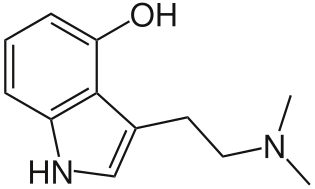
Psilocin is a metabolite product of psilocybin and is also entheogenically active in its own right. In fact, the psilocybin can be considered a method for ingesting psilocin which is far more reactive and active. Psilocybin probably is not active in its own right. Because the rates of reaction will be different for the two molecules the psycho-active effects will be different.
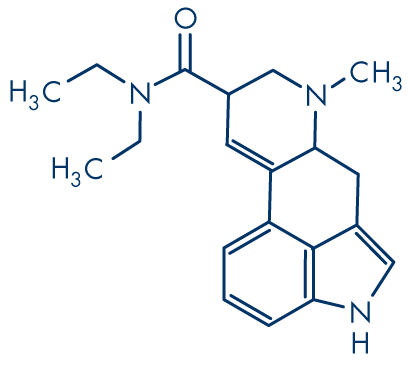
lysergic acid diethylamide
Whether it be unfortunate or not, I somehow missed the heyday of psychedelic days of the sixties. So, LSD is a bit of a mystery to me. Lysergic acid diethylamide (or LSD) has not been found in endogenous biochemical processes. There is a tryptamine structure (see below) found in psilocin present in the LSD molecule. But the LSD molecule is quite a bit more complex than the psilocin. Presumably like other drugs it allows or inhibits various bits of the brain to communicate to other parts of the brain where it would not normally. This video of fMRI brain scans gives a sense of the connectivity.
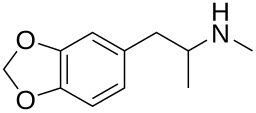
methylenedioxymethamphetamine
“Ecstasy leads to feelings of euphoria, emotional empathy, and increased energy.” Who would not want to get some of that? Well it appears there are a whole bunch of toxic side effects one may want to avoid. I do wonder how much more toxic is this drug than say ethanol in the quantities that people might normally drink. This is drug is not indole based and is an amphetamine, but it does have an ethyl amine structure in it.
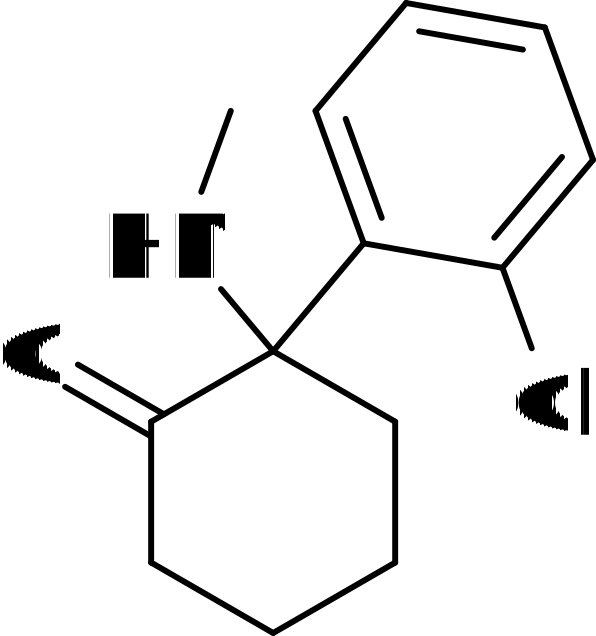
Structure wise ketamine is quite is dissimilar to the previous compounds in that it does not have an ethylamine tail in the structure. Ketamine has been extensively used as an anaesthetic especially in the field or war zones. It can produce hallucinations as the anaesthetic wears off, and there is speculation this drug is responsible for some of the near-death experiences people claim they have had. It is considered an essential medicine by the World Health Organization.
Some thoughts
One of the psycho-active benefits of magic mushrooms is the resulting vivid colours … is this intensifying the illusion? Which is the real intensity of colour, what we normally perceive or the psilocin enhanced version?
Magic mushroom seem to intensify the feelings and particularly a sense of oneness. Now for me a monistic (scientific) oneness makes sense. For me it can’t be any other way. This intense sense of oneness apparently guides us to be nice to one another. Fair enough. But do we need a Walden Two type utopia and have drugs in our water to be nice to one another? OK this is over the top, but I hope you get my point. It is a little bit like saying we can’t be good without God.
Sam Harris in his Waking Up: A Guide to Spirituality Without Religion gives a similar arguments for the use of entheogenic substances.
If spiritual moments are a form getting a hit of a soma-entheogen, no wonder, we might look for stronger hits? For me so-called spiritual moments are normally involve a feeling of awe. We are beginning to be able to study things like awe. So, it would be interesting to study the chemical changes that drove the electrical responses here.
If it were beneficial from an evolutionary point of view, then psilocin would be a piece of cake. This of course does not mean evolution has our interests or desires at heart. Just waxing lyrical here, evolution appears to be struggling against this ‘oneness’ but can’t escape it.
Pollan touched on what are the evolutionary advantages for the mushroom, of course he does not delve too deeply into this, not being his expertise. Similarly. I wonder is there not a benefit, evolutionarily speaking, to the human body to have this expanded consciousness? It’s not a huge jump from melatonin to psilocin. Or is there an evolutionary disadvantage?
Brain is releasing a cornucopia of chemicals all the time. I can’t help wondering if these everyday chemicals surging through our brains is the trip of our lives that we have become accustomed to, and all the other additives we partake in is just wanting more … and that is OK too.
I finished Pollan’s book back at the beginning of April and I had started this post back then. Could not quite get into this blog then and still not sure this is going or has gone anywhere.
Anyway, more for my benefit than anyone else’s I have compiled below some tryptophan related structures and what they do. And beyond that a little bit on opioids.
Consciousness is a trip of a lifetime
Some More Indole Based Chemicals
Below are some mostly non-entheogenic indoles that are naturally occurring, and that are related to psilocin.

One of the 21 amino acids found in nature; humans cannot biologically synthesise this essential amino acid. It is commonly found in proteins. Chocolate (dark unsweetened) seems like a favoured source for obvious reasons and it is a source of serotonin too; but meats, fish and lentils also contain tryptophan. Too low a level of tryptophan in the blood can cause depression. One can’t help speculating how individuals might metabolise tryptophan as excess can be associated with harmful effects.
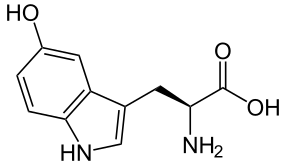
5-Hydroxytryptophan
This is a metabolite of tryptophan and is a precursor to endogenous production of serotonin. It is used for depression medication and for coming down from ecstasy. Ecstasy use depletes serotonin levels. It can be used as dietary supplement to help with depression, sleep and supressing appetite. It can produce vivid dreams or perhaps nightmares. This chemical tends to be a little unstable, so it tends not be found in nature in any significant quantity, though it is found in seeds from a shrub in west and central Africa and the seeds are used to help curb appetite.

The actual biological function of serotonin is complex and multifaceted, modulating cognition, reward, learning, memory, and numerous physiological processes (Wikipedia). It is associated with the feeling of happiness and well being.
It is endogenously produced in the brain, Serotonin itself does not cross the blood brain barrier but tryptophan does.
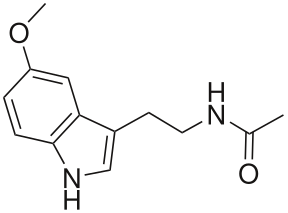
Melatonin is a hormone that helps regulate the circadian rhythm. It can be found in meats and grains, though it is primarily produced in the pineal gland and its production tends to increase when it gets dark. It is produced in the body in several steps with serotonin being one of the intermediary products. It is produced synthetically and can be used a sleep aid.

Substituted derivatives of parent compound tryptamine for the three compounds above (plus psilocybin and psilocin) represents a whole range of interesting compounds. Tryptamine itself is found in trace quantities in the brain of humans and other mammals. Many plants contain tryptamine.

DMT is the methylated version of tryptamine and is produced in the human brain at very low concentrations and is involved in certain psychological and neurological states and is naturally occurring in small amounts in rat brain, human cerebrospinal fluid, and other tissues of humans and other mammals. Untested hypotheses suggest that endogenous DMT produced in the human brain is involved in certain psychological and neurological states. (Wikipedia). Nevertheless, in larger doses it can produce hallucinatory effects.
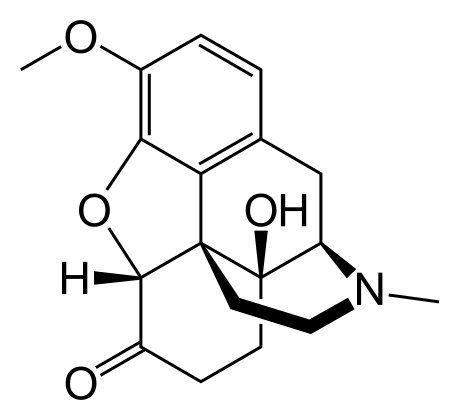
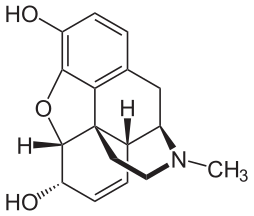
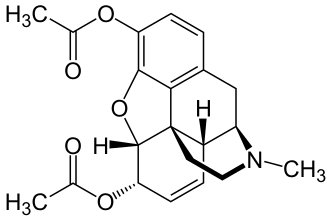
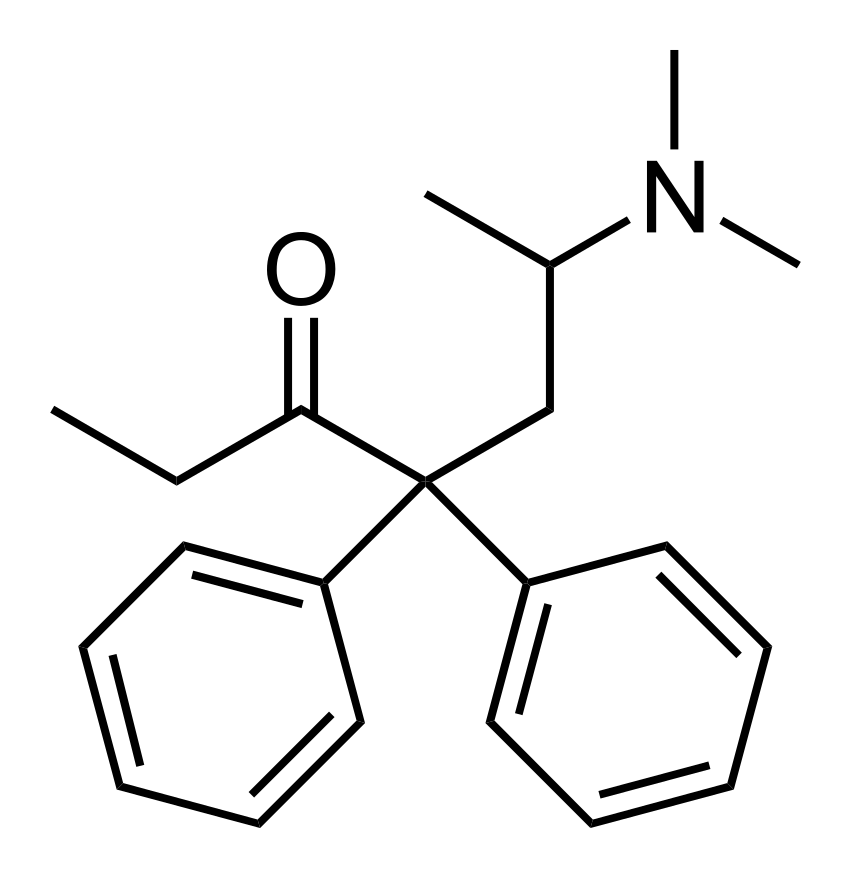
Some Opioid Structures and Methadone

Cannabis relations
Two common cannabinoids of 113.


Thanks for the insight into you and your profession. Not at all a chemist, it was interesting to see the diagrams and thus the similarities between morphine and other related substances.
Curious your comments on “oneness” with the universe, and spirituality. Wouldn’t mind hearing more.
Drugs is to spirituality as rape is to love! Can’t buy that. Jesus, Muhammad, John the B all supposedly fasted, deprived themselves of sleep, wondered in deserts and holed up in caves; that surely altered their chemical composition. The Buddha too.
Grew some opium poppies this summer. A lovely flower. Thought about brewing up some tea. Will let you know.
LikeLike
Well alcohol on the whole does not make me feel more spiritual … though given the optimum dose I can feel content at certain times.
In Bacteria, Bach and Back Dennett has a colour plate that is a schematic of what evolution looks like (not supposed to be accurate). For me it was like a metaphor for our existence. It was a cartoon for a particular aspect of our universe unfolding. While the surface of the evolutionary chart shows the lineage to various ancestors there are dotted lines at each time connecting everything in that this “everything” is our environment including the inanimate. The environment shapes the individuals and the individuals shape the environment.
People tend to draw arbitrary (though useful) boundaries [structures if you like] around themselves, others and other bits and pieces of the universe. If we don’t draw these boundaries then it is “one”. At this point we can see free will for the illusion it is.
LikeLike