
Islam has two major branches, Sunni being the predominant one. Shia is by far the next largest branch. The split was not theological but was initially hierarchical. This occurred at the outset of Islam. Sunnis favoured an elected leadership model from the wider tribe. And Shias thought leadership should remain in the Muhammad line. Within these groups, there are movements and legal schools, and no doubt other lines of thought. Ibadis believe leaders should be elected for their piety and merit. As for the Ahmadis, they are not accepted by the two major Muslim traditions. The Ahmadiyya movement might be described as modern, as in relatively recent, but not in modern thought. Essentially, the Ahmadiyya movement has been compared to Mormonism and mainstream Christianity. Then there is Sufism, not a branch. Basically, a form of Islamic mysticism that informs the three major branches and the modern movement less so. I suspect that if I knew a bit more about Sufism, I might develop a soft spot for some aspects of it. Below, we can find a theological map of Islam.
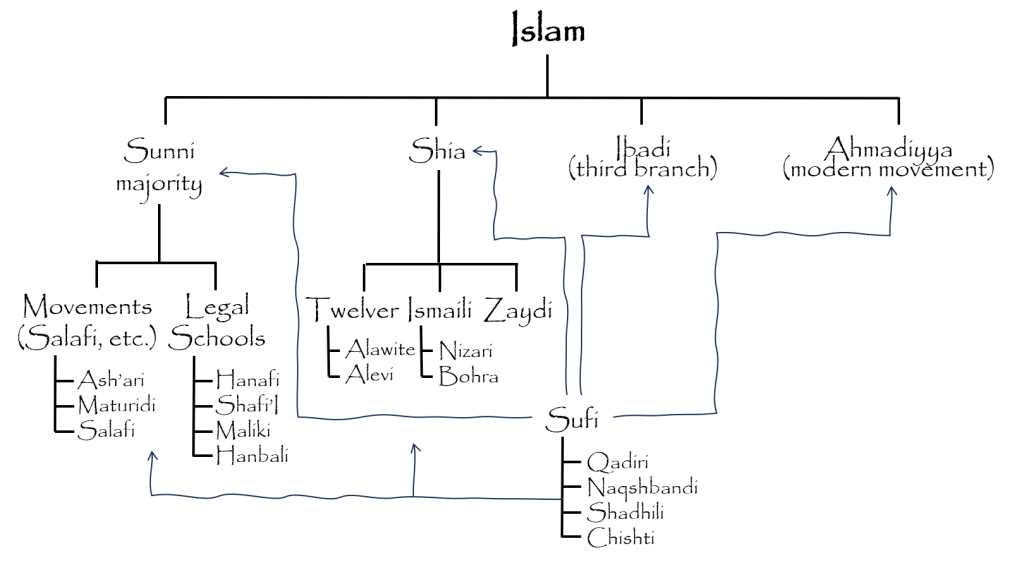
I am not familiar with Islam and have barely scratched its surface. And of course, as usual, the twenty or so labels can’t describe the beliefs of two billion people all that accurately. So, my observations on Islam come from a handful of interactions, news reports, minimal research, and a variety of discussions. The usual caveats apply.
Delving into what most Muslims believe, at least to some extent.
The core beliefs or the six articles of faith [islamonline.net]
Belief in:
• One God (Allah) – absolute monotheism (Tawhid)
• Angels
• Holy books (eg the Qur’an)
• Prophets (particularly Muhammad as the final prophet)
• The Day of Judgement
• Divine decree (predestination)
The belief in one God is more or less standard fare. Of course, questions arise like why believe in any at all? Monotheism seems understandable from an Abrahamic perspective, the Sikh perspective and a Brahman view. Though in Hinduism, this is clouded by bhakti, the polytheistic aspect. So, as far as it goes, no major problems here; I am not overly fussed; monotheism seems more reasonable, and it is not overly surprising that someone might believe it. Outside of scriptural texts, there seems to be little evidence for a caring God. Most non-theological arguments seem to come from an argument from incredulity or ignorance.
To me, it seems strange to have angels as a core (necessary) belief. I have reviewed Billy Graham’s Angels early on in my online life. And more recently, angels in the post “Beliefs”, our capability to have strange beliefs. Regarding our belief in the Qur’an, for me, it is how we believe. What are the logical reasons that the Qur’an must be true? We’ll come to that in more detail later. And of course Muhammad existed, and to varying degrees, the other prophets probably or might have existed. This seems reasonable up to a point. Day of Judgement, colour me skeptical? And I am curious about how divine destiny is somehow compatible with free will?
The five pillars of Islam [britannica.com]
The core practices are:
• Shahada (Declaration) – Declaring, There is no god but Allah, and Muhammad is His messenger.”
• Salah (Prayer) – Praying five times a day at specific times
• Zakat (Charity) – Giving a portion of wealth to those in need
• Sawm (Fasting) – Fasting during the month of Ramadan
• Hajj (Pilgrimage) – Travelling to Mecca at least once if able
Shahada Is the declaration of one’s faith. If by faith we mean belief without evidence or even despite the evidence, then you can count me out. Apparently, Islam uses the word iman and “faith” is the closest translation. Iman1 “implies a deep, rooted conviction in the truth of something, as well as a sense of loyalty, commitment, and devotion. It also suggests a sense of security and peace that comes from having faith in Allāh and His guidance.” This seems to be a primary condition of being a Muslim. Christian apologetics can try to shift the meaning of faith toward the rational, but, to be fair, the simple definition of Iman does not identify the source of the conviction. While the Qur’an does suggest the use of reason (Aql), it also concludes that there is a creator and that the Qur’an is the creator’s perfect message.
Salah While prayer can have many of the features of salah, salah itself is highly prescribed. It has fixed timing: dawn, noon, afternoon, sunset, and night. Must be clean and wearing modest attire. The praying is highly ritualized: cycles of standing, bowing, and prostrating (Rak’ahs). Specific chapters of the Quran and praises of God are recited. Sujud (prostration), where the forehead touches the ground in absolute submission, is apparently a bit of a highlight when it comes to Muslim prayer. In contrast to Christianity, while there are ritualized aspects to prayer, it would appear God is not as fussy regarding attire and ritual. Prayer can be free-form. Perhaps even a simple meditation. Now I can’t say that this ritualization of prayer is or is not ‘meaningless’, but Jesus did suggest meaningless rituals should be avoided – Jesus warned his followers not to use “vain repetitions” or babble on like pagans, who incorrectly believed that long, repetitive phrases would force God to answer them2. Of course Muslims would claim they are not meaningless. As I noted in Sikhism, I wonder if the frequent routine in prayer can lead to a mode of self-programming. There is a hint in this Pew survey3, Muslims who pray five times a day are more likely to favour Sharia law than those who pray fewer times. We can’t be sure here whether we are looking at the cause or the effect.
Zakat Charity? No protestation here. All in favour of it. There are Abrahamic precedents, and I would be very surprised if this were not the source of Zakat.
Sawm Fasting, a little bit of fasting is unlikely to hurt anyone. May even benefit some if done wisely, certainly would not hurt me. The Qur’an acknowledges the precedents. (As those have done before you). Apparently, there is a spiritual benefit to this.
Hajj Well, I suppose travel broadens the mind. I can’t help thinking this is simply an extension of faith and prayer.
Preservation
By preservation, scholars mean how unchanged a scriptural text is over time. To be fair, compared to the Bible, the Qur’an has remained relatively stable. Much of the change that has occurred is a result of changes in spelling and typography. Early texts lacked short vowels and diacritical dots. This has led to some tension when trying to interpret the earlier texts, as without the short vowels and dot, interpretation can be uncertain. In 1924, the Qur’an was standardized
The preservation is in part due to an early campaign to standardize the Qur’an. Also, the Qur’an was documented over a short period of time, say, compared to the Bible. The Qur’an was written in the relatively modern seventh century. Geographically compact and in the Arabic language. It could be argued that the state systematically destroyed the competing written codices.
Some Muslim apologists hold great store by the high preservation; some go as far as to say it was perfect. They seem to suggest that the preservation is a sign of God’s perfection.
Literalism
I have a lista of events in the Qur’an that I cannot accept literally. I am sure if necessary, I could expand my list. Some of them I would even struggle with as a metaphor. I’m certainly not an expert on the Qur’an. But like the Bible, it contains much that is factually incorrect if taken literally or perhaps unverifiable. Muslim apologists seem to go to great lengths to harmonize the idiosyncratic content with reality.
There seem to be three broad categories where we have unbelievable or unverifiable claims.
• Supernatural Miracles. God controls physics. Sticks can turn into snakes, no problem. This, of course, is not an explanation, but an abdication of an explanation.
• Historical Inaccuracies. The defence seems to be: a lack of evidence is not a disproof. Abraham and Ishmael built the Kabba. But until we have the Qur’an, there is no record of this apparent event. There is no mention for two thousand years. It is unclear and probably unlikely that Mecca, in any form, existed in Abraham’s time.
• Poetic Language. Acceptance that these things are not literally true, but more allegorical or metaphorical in nature. ie The sunset beyond a muddy pond rather than literally in it.
Inerrancy
This disturbs me most about Islam and Muslim apologetics. There is almost a sense of arrogance in the claim of inerrancy. If the stories about earlier prophets in earlier traditions do not match those of the Qur’an, then the earlier stories have been corrupted, possibly by the devil. The belief that the Qur’an is literally the word of God puts Muslims in a difficult spot. In comparison, Christians largely claim the Bible is inspired by God, so there is some wiggle room to allow uncertainty.
It is claimed that the Qur’an reads beautifully in Arabic. I accept this possibility. And this is one of the attributes that make this the perfect word of God. But beautiful prose is not necessarily an ally of precision, accuracy, or clarity. Setting aside the literal inaccuracies we have, the question I have is: if we have this perfect Qur’an, why do we need the Hadith to explain and interpret it for us? A classic example is how the Hadith handles adulterers compared to the Gospel of John. Would not the perfect word of God make it clear for us mere mortals, so that other fallible mortals don’t have to act as intermediaries? To add to the dilemma, the Qur’an does not translate well into English. It would appear God chose a messenger whose universal message was in a language that even God has difficulty making the meaning clear.
Complete
The Qur’an is the complete guide: it is the ultimate, fully detailed guide for human salvation, morality and spiritual law. It contains the finalized message of God, requiring no further amendments or new scriptures … or words to that effect. I am not sure where to begin. So I will leave it at that.
The Qur’an is such a perfect book that anyone who comes not believe in it was never a true Muslim. In that case, the crime of apostasy is impossible. </joke>
Practice
Sunni – Shia divide As mentioned earlier, the source of leadership was in dispute. Also, the nature of the leader. Sunnis recognize their leaders as fallible and simply as administrative leaders, but Shias see their leaders (Imams)as appointed by God and consequently infallible with spiritual authority. These Imams are treated as saints by Shias, which is forbidden by Sunnis or at least minimized. In the Shia tradition, temporary marriages are allowed by contract but seen as fornication by Sunnis. For Shias, a primary focus is loyalty to the oppressed family of the Prophet (Walayah). This, I presume, extends to the present-day Shia
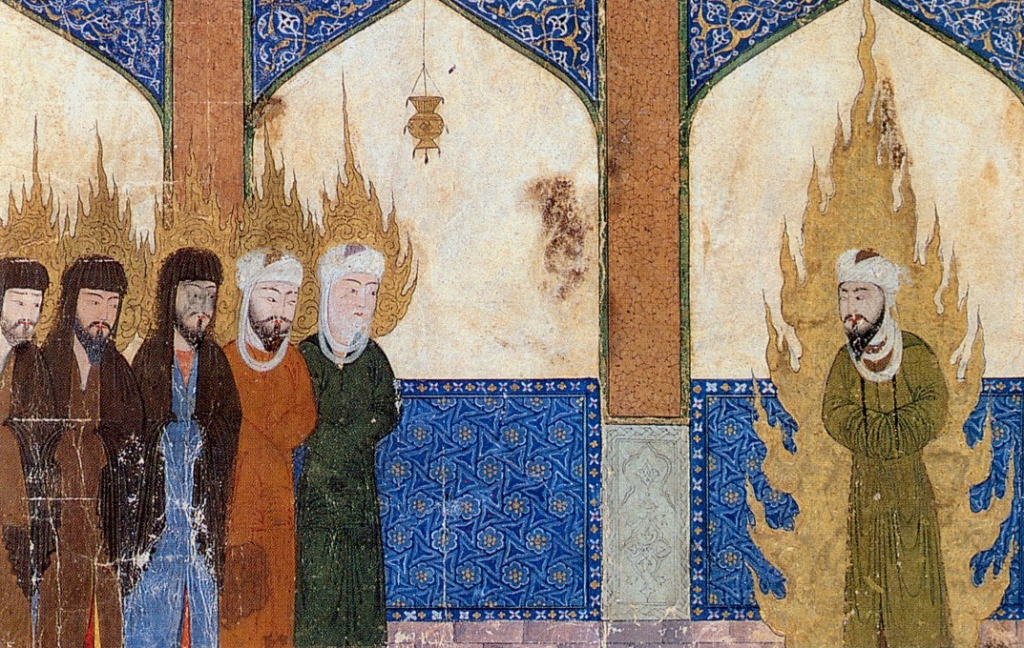
I must admit, I did find the prohibition of depicting Muhammad or other prophets in paintings or drawings puzzling. The prohibition comes mainly from the Hadith; not explicitly from the Qur’an. Particularly in some Sunni traditions, depicting Muhammad risks idolatry and, therefore, is disrespectful of Muhammad. Yet the painting to the right was commissioned by a Muslim for Muslims. In some Muslim traditions, Muhammad actually sat for paintings. Of course, not all depictions are intended to be or will be respectful. I find in Islam the language used around Muhammad, Jesus, or any other of the prophets could be accused of being far more idolatrous. For example, Peace Be Upon Him for Muhammad and others, Upon Him be Peace for Jesus.
Imams. The Sunni-Shia violence dates back to the 7th century, when Muhammad’s son-in-law. The leader, was challenged, resulting in a civil war and ultimately Ali’s assassination. Of course, there have been plenty of politics, intervening events and the current Saudi Arabia-Iran ‘cold war’ does not help. The point being, Islam, the religion of peace like other religions, do not live up to their mantra.
Sharia On paper, Sharia has much in its favour. For example, a total societal safety net. If we are socially left-leaning, this is excellent. As it is practiced, not so much. Immigrant workers in Islamic countries generally do not benefit from state Zakat. Under Sharia, legal rulings are to preserve: life, intellect, religion, lineage, and property. Yet for certain crimes, capital and corporal punishment are advocated. Moderate Muslims are not exactly encouraged; they tend to be more prominent in non-Muslim countries. Preserving religion, if it is Islam. Children out of wedlock can be discriminated against. Heretics are not guaranteed their property rights in many places. Possibly a positive for the future, not all Muslims claim Sharia is the revealed word of God, see panel on the left. And not all Muslims think religious judges should decide family and property disputes, panel on the right.


Ridda -Apostasy Apostates come in two forms. There are Muslims who are moderate and advocate change within an Islamic framework. They are not immune to death fatwas or excommunication. Some examples include Dr. Nasr Hamid Abu Zayd, a highly respected professor at the University of Cairo. For arguing that the Qur’an should be interpreted using modern literary criticism and historical context, he was declared an apostate and forced to divorce his wife. He had to flee Egypt under police protection and live in exile. Remember that under Sharia, legal rulings are to preserve: life, intellect, religion, lineage, and property. Farag Foda was assassinated after he advocated for the separation of mosque and state. A fatwa was issued by a group of university clerics. Mahmoud Mohamed Taha was executed by the Sudanese government for apostasy after being accused by two lecturers from the Islamic University of Omdurman, backed by the Islamic Charter Front, spearheaded by Islamist leader Hassan al-Turabi. While not a fatwa/legal opinion per se, it must be disturbing for moderate Muslims.
Then there are true apostates who leave Islam and even those who advocate against Islam. Some people make fun of the idiosyncrasies that can be found in Islam and other religions. Then there are the rest of us folk who are uneasy about Islam, or literally don’t care and are indifferent.
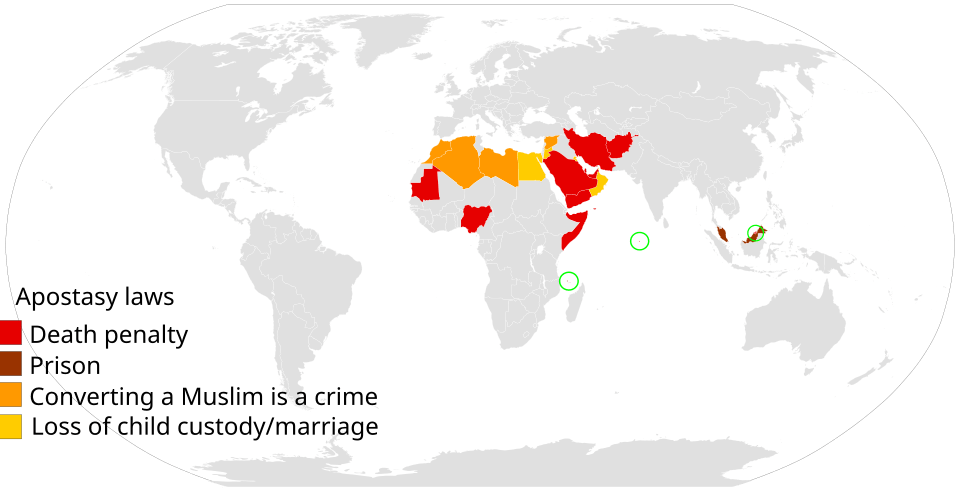
Apostasy proper. There are enough famous cases out there. But generally, this type of violence comes in three forms. State (theocracy) sanctioned violence, vigilanteism and familial honour killing. Note the countries where apostasy is a crime are those that are primarily Muslim. An exception is Nigeria, and apostasy only applies to the primarily Muslim regions. I can’t help thinking that Islam must be an unconvincing religion that needs to enforce belief with apostasy laws. Is Allah not a wise enough God to see into people’s hearts? And then we have things like Charlie Hebdo and the Danish cartoons, while not apostasy per se, it points to a belief in a God that needs human support.
Mystics – Sufi
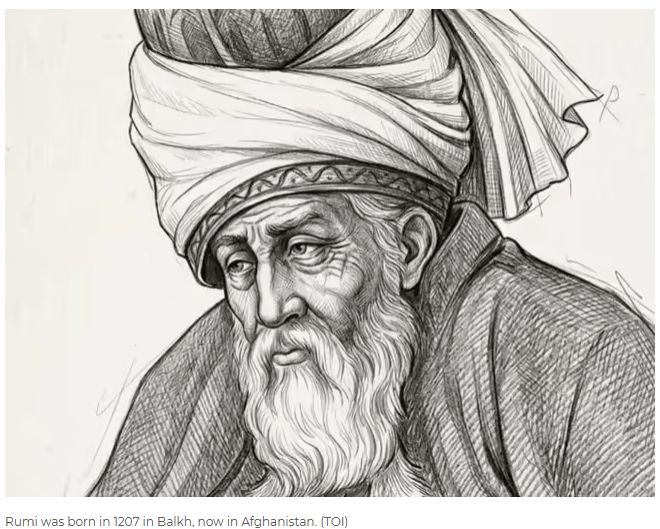
As I said before, I have a soft spot for mystics. They don’t always follow the dogmatic line. My wife enjoys translations of Rumi’s poetry. My wife’s favourite Rumi poem is The Guest Houseb. I think I sort of ‘get it’, and it is a nice take on acceptance of our many moods. Having said that, Rumi was never a heretic mystic in the same way Meister Eckhart was to the Roman Catholic church. But some of Rumi’s teachings might be considered on the cusp by some.
Just a shout-out to Joseph Campbell here: his observation that the one thing atheists and theists have in common is that both take the religious texts literally. I suspect it is more anti-theists than atheists, though his point remains. I am willing to test the lens of metaphor and allegory. But then, is the average Muslim? How much sense will the Qur’an make to me as a non-Arabic speaker?
And Overall?
I have to admit I had a bias against Islam before embarking on this post. This review did little to reduce the bias. Like many religions, it has it heart in the right place. Perhaps the moderate Muslims have not had the opportunity or platform to soften the harsh edges of literalism, inerrancy, and completeness. Perhaps there are many moderate Muslims, but for whatever reason their voices did not reach this blog with any intensity. They seem as though the they are protected in the universities of the secular West.
Compared to the more philosophically nuanced Brahman and Ik Onkar (one unity) of Sikhism, the Islam I encounterd seemed harsh.
a Literalism List
1. Creation of Adam from Clay – (Qur’an 38:71-72)
2. Creation of Eve from Adam – (Qur’an 4:1)
3. Angels Bowing to Adam – (Qur’an 2:34)
4. Iblis (Satan) Being Made of Fire – (Qur’an 7:12)
5. Talking Animals: ants – (Qur’an 27:18-19): Ants – (Qur’an 27:18-19), Hopoe -(Qur’an 27:20-22)
6. Solomon Controlling the Wind and Jinn – (Qur’an 21:81-82, 34:12-14)
7. Staff Turning into a Snake – (Qur’an 7:107-108)
8. Parting of the Red Sea – (Qur’an 26:63)
9. Turning the Nile into Blood – (Qur’an 7:132)
10. Jesus Speaking as a Newborn – (Qur’an 19:29-30)
11. Jesus Creating Birds from Clay & Bringing Them to Life – (Qur’an 3:49)
12. Jesus Healing the Blind & the Leper – (Qur’an 3:49)
13. Jesus Raising the Dead – (Qur’an 3:49)
14. Ascension of Jesus Without Death – (Qur’an 4:157-158)
15. Muhammad’s Night Journey and Ascension (Isra & Miraj) – (Qur’an 17:1)
16. Splitting of the Moon – (Qur’an 54:1-2)
17. The People of the Cave Sleeping for Centuries – (Qur’an 18:9-26)
18. Jonah Being Swallowed by a Giant Fish & Surviving – (Qur’an 37:139-148)
19. Fire Not Burning Abraham – (Qur’an 21:68-69)
20. Mountains Being Pegs Holding the Earth in Place – (Qur’an 78:6-7)
21. Gog and Magog (Yajuj & Majuj) Trapped Behind a Wall – (Qur’an 18:94-98)
22. Dead Man Brought Back to Life by a Struck Cow (The Heifer Story) – (Qur’an 2:67-73)
23. The Kaaba Being Built by Abraham and Ishmael – (Qur’an 2:127)
24. The Resurrection of All Humans on the Last Day – (Qur’an 36:78-79)
25. Hell and Heaven as Physical Places with Literal Rewards and Punishments – (Qur’an 56:10-56, 76:12-22)
26. Noah and the Flood (Qur’an 37:77)
27. Angels Assisting in Battles – (Qur’an 3:123-125, 8:9-12)
28. Mountains Lifted Over the Israelites as a Threat – (Qur’an 7:171)
29. The Beast Emerging from the Earth at the End of Time – (Qur’an 27:82)
30. The Sun Setting in a Muddy Spring (Dhul-Qarnayn’s Journey) – (Qur’an 18:86)
bThe Guest House
Jalaluddin Rumi
This being human is a guest house.
Every morning, a new arrival.
A joy, a depression, a meanness,
some momentary awareness comes
as an unexpected visitor.
Welcome and entertain them all!
Even if they’re a crowd of sorrows,
who violently sweeps your house
empty of its furniture,
still, treat each guest honourably.
He may be clearing you out
for some new delight.
The dark thought, the shame, the malice,
meet them at the door laughing,
and invite them in.
Be grateful for whoever comes,
because each has been sent
as a guide from beyond.
1 The Meaning of Iman – Quranic Arabic For Busy People
2 Matthew 6:6-8 KJ21 – But thou, when thou prayest, enter into – Bible Gateway
3 https://assets.pewresearch.org/wp-content/uploads/sites/11/2013/04/gsi2-chp1-4.png


