
This piece was originally meant to be about spirituality and the concept. Somehow it morphed into awe.
Spirituality
Maybe thirty or forty years ago I would have described myself as spiritual and not religious, or at least not religious in any traditional sense. Boring, I know. Looking back, I think I meant there is something more to life than mere existence. Apparently, spiritual can refer to our soul, a higher consciousness, or spirit. It is an ephemeral concept. I don’t know what a higher consciousness is; I don’t really believe, never did, in an immaterial soul. Spirit; you have got me here? A boundary with ego. Somehow making meaning; I don’t know? Sagan’s secular spirituality? Perhaps a reasoned feeling developed with interaction with aspects of the universe.
I recall going to a church remembrance for a pastor friend. He had left the area and started up a small business and two years later died. The service, of course, was gushing. Which was ironic, in that he had left the church under a cloud, having made choices that the congregation as a whole disagreed with. I remember some congregants becoming positively euphoric during the modern hymns. I recall a similar experience, partially alcohol induced, me and a group of friends in a huddle singing along to Hey Jude. And I suspect we are all familiar with images of charismatic evangelicals letting in the spirit of God. No doubt we have similar instances in other religions; whirling dervishes come to mind. Repetitious chants of Hare Krishna, prayers five times a day might also do the trick. Is an aspect of spirituality a self-induced body chemistry? I am reminded of my Chemical Spirituality post, at least the latter half.
Anyway, on to the subject of awe.
The Experience of Awe
Of course we all, I presume, experience awe at different times and in different situations. And no doubt it is difficult to reconcile my experience of awe with yours.
Large structures and large crowds have brought me a sense of awe. One of my earliest recollections would be my first football match at Villa Park. The ground was electric with an anticipatory hum. A similar occasion was at Turffontein racecourse; waiting for the first race, the air was charged, not with the sparse white crowd, but from the fenced-off black section. Cathedrals and even humble little churches can seed a sensation of awe. While not a manmade structure, the wilderness can also be awe-inspiring when the scenery is majestic.
In a brief stint as a teacher, an experiment was to demonstrate crystallization. I believe the experiment used phenyl salicylate. A few crystals were placed on a microscope slide and heated in a flame to melt the crystals. Another slide was added to form a thin film between the two slides and placed into one of the old-fashioned slide projectors. The image was projected onto a white wall. As the film cooled, a beautiful montage of growing crystals was formed. This was just a practice run. The next day, this was repeated for a class of twelve-year-olds. My sense of awe was repeated, but this time echoed with thirty kids.

Zygote: Madeleine and I could not have children, and we had a few IVF attempts. On the last attempt, the doctors offered a view of the “embryo” about to be implanted. Looking down the microscope was like looking into the universe. From this speck, a couple of microns in size, a potential human being might form. Sadly, it was not to be. Having said that, I would not be here writing this if all had gone as hoped for.
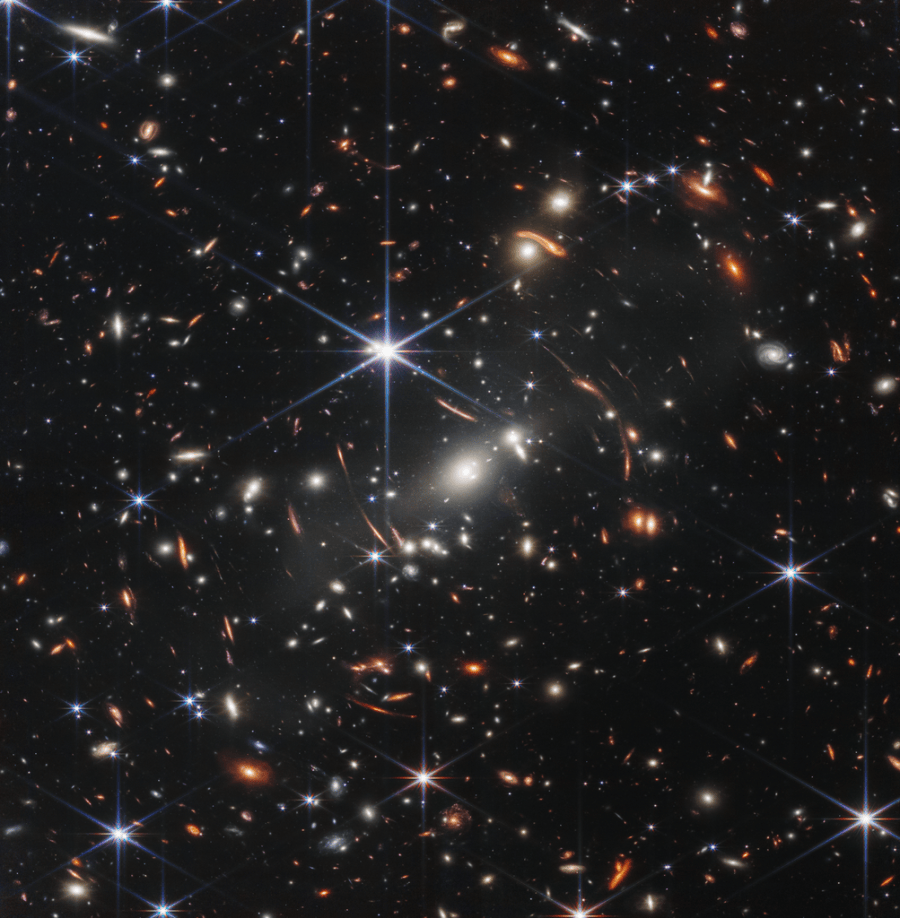
The universe: I can remember the first time I saw the Milky Way. I was seventeen, on Llangorse Lake, fishing at night for eels with my Dad. Growing up in Birmingham with all the street lighting and weather, the thought of the Milky Way never crossed my mind. Seeing it gave me my first insight into our insignificance in the great scheme of things. The second time I saw our galaxy was in Chile, heading down from the Andacollo Basin. The driver stopped to take a phone call; I stepped outside, and there was our galaxy, in ever more detail, in a crystal-clear night. Even a photograph of the night sky can bring chills. The first image released from the James Webb telescope was of a speck of sky just filled with galaxies. And of course we have Carl Sagan’s Pale Blue Dot.
Physics has given me moments of awe. I have mentioned Mr Batey telling us that our biological trichromat cones and our sense of colour ‘simply’ involve photochemical reactions, electrochemical signals, and signals being processed in the brain. Mr Batey stood there for a few seconds as if we should be processing this bit of information. If the truth be known, he had me at the previous lesson, where we learnt that objects absorb and reflect light. So, does an object even have a colour? And of course, we have the Cavendish experiment, where we see gravity in action and can calculate the mass of the Earth. But seeing the large lead weights be attracted by the larger weights (masses) was a magical moment for me. Earth’s gravity feels ubiquitous and mundane; we had the theory, but seeing it on a ‘microscopic’ scale was awesome.
More: I can remember having an existential moment, maybe thirty years ago, in the backyard, sitting on the grass, looking at a beautiful blue sky, thinking there has to be more to life than this. I was in a state of wonder. The moment of wonder passed, and this particular existential instant has not returned as yet. Related to this, I suppose, is somethingism. A word for this is Ietsism; it comes from the Dutch. Today I can sit and look at the grass and think, why do we want this more? This latter thought is not in awe or wonder, but fully in reason.
Music: There can be something about music that is awe-inspiring. While not musically inclined, I asked to take extra maths to get out of music class. Classical music, with extra infrasound: Bach in particular. The mass choir. Stairway to Heaven. We all have our bit of music that will send a shiver down our spines.

Art: Like music, art can inspire moments of awe. Riverdance is a classic example for me; seeing it only on television nevertheless worked for me. Similarly, Cirque Du Soleil-type performances also work. A copy can be found at ALMA, south of Puerto Vallarta. Walking through the jungle to the amphitheatre and a dinner by the sea. Definitely magical. Of course this may have been amplified by our first Christmas without James. I will come back to this mystical type theatre.
James: Looking into the eyes of my son for the first time! I was not sure about love at first sight, but now I’m a believer. I remember gazing in wonder at the joy he expressed when taking his first steps. I still have a photo of his joy.
Grief: Looking back nineteen years to James’ death. The months, if not a year or two afterwards; the grief I felt was not dissimilar to awe. Joseph Campbell was a companion to me then. He noted that in moments like these we are susceptible to taking on new worldviews or new directions. Music and stories were written just for us. But with the grief, there was a certain numbness. I recognized that grief is not a bug, but a feature. Evolution’s way of telling us not to lose our loved ones. There was a moment when I found myself thanking James for his death, letting me feel such an intense emotion that I had never felt before. Even if this feeling was painful. Over the years, the tsunami of grief has subsided. Today the odd wave brushes past like an old visiting friend. In the end, I was thankful for the sixteen or so years I had with James. More years would have been nice, but it was not to be.
Practice
With the exception of grief, these moments only last a few seconds, a minute tops. But there is a residual memory of wonder. I can’t help wondering what the chemical changes are that cause the sensation of awe and how the neural networks are reconfigured. Before James’ death, I had not looked at a philosophical type of book. I would not have dreamed of it. I don’t think I was looking for meaning in his death, because I did not believe then, nor do I believe now, that there is any meaning beyond what we might illude or conjure up.
The feeling of awe comes far too infrequently for my taste.
Cosmos and everything
People claim having a sense of awe will promote all kinds of benefits. The experience of awe might not be seen as pleasant by all people. Apparently, individualistic cultures are more likely to perceive awe as a positive experience. Whereas, communal societies are less likely to feel a positive response.
Here are some claimed benefits of awe:
Diminished Ego: Participants reported feeling “smaller” but simultaneously more connected to the world and others. [1, 2]
Comfort with Uncertainty: Awe decreased the human need for cognitive control and a “need to be right,” making individuals more open to new experiences and empathy. [1, 2]
Increased Curiosity & Risk: The emotional reset reduced stress and counterintuitively opened individuals up to higher risk tolerance and greater curiosity.
A few months after James’ death, I started losing my belief in free will as a result of discussions where I could no longer defend the concept of free will. I have to admit I recall going into a bit of a funk. The realization that the world is not as it seems. I quixotically endeavoured to visualize the world as it might be. Awe is not always rainbows and starlight … it can be messy and scary. After a few weeks, normal service was resumed; well, what passed as the new normal
Is awe a moment when our body chemistry shifts from our routine trip of a lifetime and drops a gear and revs up to a high rpm?


