
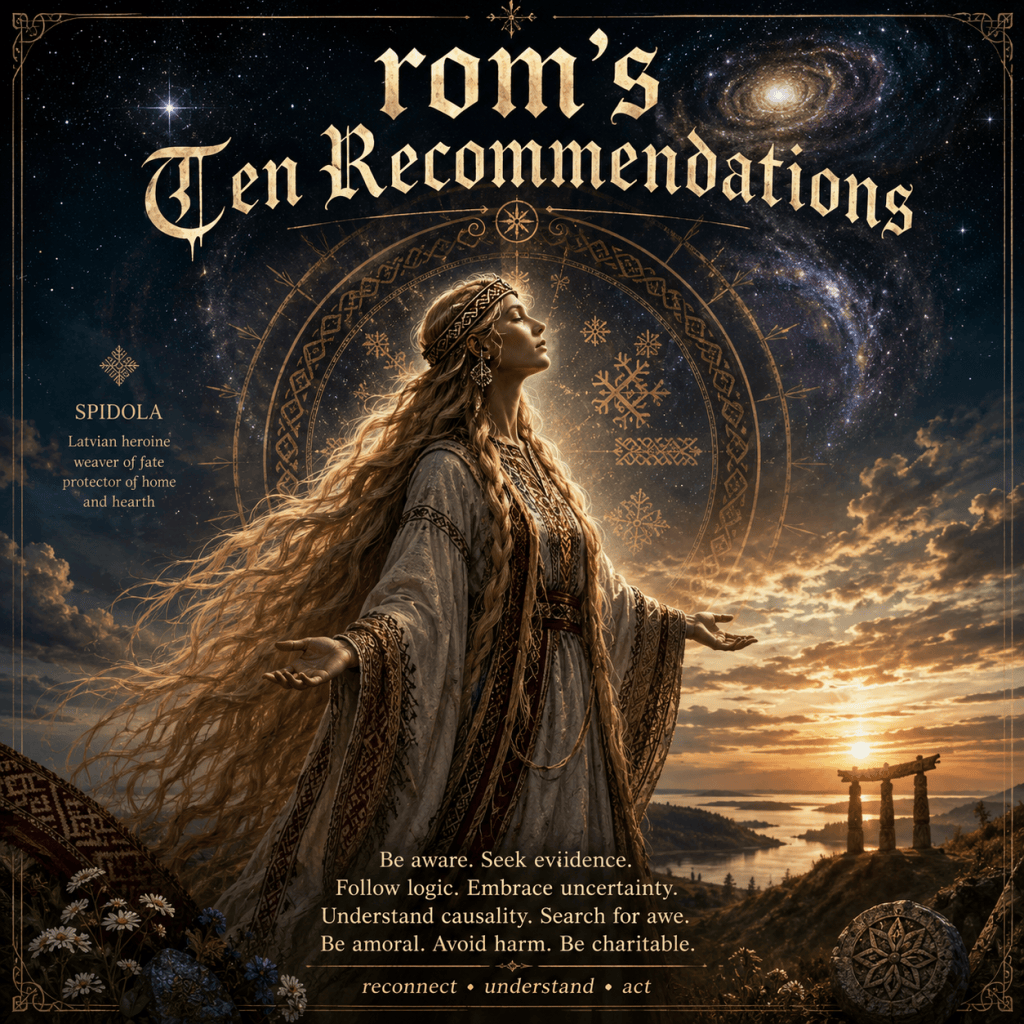
The etymology of the word religion comes from the Latin: re ligare, again connect or reconnect. But connect to what? Our God, society, nature, humankind? For rom, it is about reconnecting with the universe. But also to recognize we were never separate anyway. Every bit of material or allegedly immaterial rom came from elsewhere and will return to that elsewhere.
rom’s religious ten recommendations from upon high:
- Be aware.
- This is something many of us will find difficult, to some degree. But be aware of what?
- First, we might find, if we examine our internal machinations, that we are not very aware of them at all. We might find that all we are aware of is some high-level verbal summary, perhaps a confabulation of what we think happens.
- Watch how our reflexive emotions shape our thought and body chemistry, and how our body chemistry shapes our emotions.
- See how our families, friends and society shape our perceptions and even beliefs.
- Watch how the world unfolds in all of its splendour and horror makes us feel.
- Look at the stars on a dark, cloudless night sky, and examine our feelings.
- Seek evidence for belief.
- Ideally, we might shape our beliefs based on evidence, but this might not be that common.
- Having found ourselves with a belief, finding evidence for that belief makes sense. Conversely, finding evidence that contradicts a belief makes sense to re-examine or even drop the belief.
- On the positive side, finding more corroborative evidence might strengthen our belief.
- Follow logic
- We first set our premises, axioms and definitions.
- Then we apply our skills of logic to the premises and arrive at a conclusion.
- It does not hurt to check our logic and make sure we have not applied formal or even informal fallacies in obtaining our conclusion.
- Question assumptions.
- Logic will be of no use to us if we feed it with false premises and axioms.
- We can arrive at logically valid conclusions even if the premises are false. So, we must check the accuracy of our assumptions for the logic to hold.
- Even in everyday conversations, it does not hurt to check our assumptions. They can be flat out wrong, or perhaps we can find ourselves overgeneralizing.
- One of the biggest obstacles to us questioning assumptions is overcoming our built-in intuition for naïve realism.
- Embrace uncertainty
- There is a kind of strength in saying, “We aren’t certain”, or “We don’t know.”
- George EP Box’s quote All models are wrong, but some are useful, is a sanguine reminder for us. This was aimed at statistical models, but it is useful for dealing with uncertainty.
- Hold all conclusions tentatively, and we can be prepared to dump an idea or belief.
- Continually revise our beliefs as new evidence and understanding develop. We never know our position may grow stronger. Bayes may come to help us.
- We can leave uncertainty behind, but it always follows us in the rearview mirror.
- Understand causality
- This is not to assert we hold causality as true, but to understand the ramifications if true.
- Having said that, we seem to believe in causality. If we do stuff, we expect or hope our actions have an effect. We understand that sometimes the effect is refractory to the action.
- Causality might be deterministic or indeterministic. If causality is deterministic, we might make sense of our actions. If indeterministic things get truly interesting.
- If causality is false, then we need a serious review of our perceptions.
- Search for awe
- While awe is an interesting sensation, it might not be for all of us.
- According to Joseph Campbell, one of the purposes of myth is to provide us with a sense of awe. And here myth and religion might be used synonymously.
- These recommendations of themselves won’t provide us a sense of awe, but can be found in observing and understanding how the universe ticks.
- Be amoral
- We can put aside our instinct for good and evil.note
- And recognize that moral and immoral are useful placeholders for actions that we instinctively see as desirable/beneficial (to society’s wants) or not.
- We might see this as a mild form of hedonism; what benefits our broader society will, in the long term, also benefit us.
- In short, let’s not think in terms of good and evil. There is a Biblical precedent if this is important.
- Avoid harm
- Of course, we may not be able to completely avoid causing harm.
- Also, harm to what? Does this advocate for veganism, anti-natalism, or some such worldview?
- In some sense, we live in a resource-limited world, so anything we ‘consume’, we will deny to someone or something else.
- Anything we do will have unforeseen consequences.
- Having said that, we can minimize our consumption. Minimize our global footprint.
- Be charitable
- Here, we can be charitable not because it is in some way good, but because it will be beneficial to us.
- If we can afford it, share our resources or wealth.
- Donate some of our time for others.
- Be charitable with our intellect as well, understand that if things were different, we too could be in need.
- And last but not least, we can be charitable to ourselves as well, especially intellectually.
These recommendations do not tell us what to think, but suggest how we might think. There is no need for salvation here, only the hope that by better understanding reality, we might also better understand ourselves, each other, and how we connect to the unfolding universe.
To steal a concept from Joseph Campbell’s ‘Power of Myth‘,
rom shows us the way, but it has to be our way.
Author’s note … being amoral, there likely will be some pushback here. This is more a criticism of the concept of morality. There is a whole realm of amorality from quantum physics to the cosmos. There is some skepticism that the concept of morality applies to an infinitesimal portion of the universe, especially if we are connected to the universe. Amorality is not about cruelty; it is about how the universe has unfolded. Hopefully, we might be motivated to do something about cruelty, if and when we see it.


