
What is Happiness? came into one of my Facebook feeds. Some thoughts on the scholars’ thoughts on happiness can be found below:
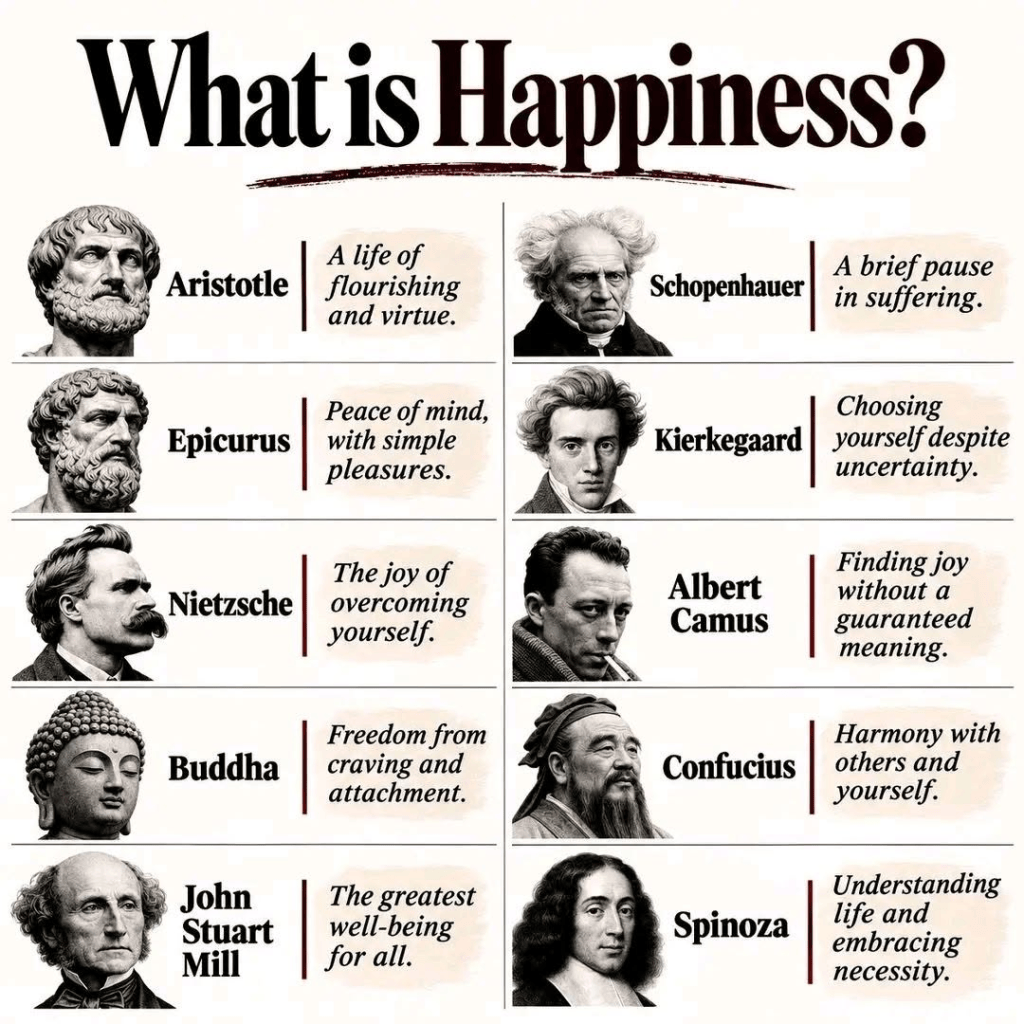
To note: these apparently are not actual quotes but summaries or interpretations of the various philosophers’ positions. So the whole shebang is an open question and discussion. Anyway, my take:
Aristotle: A life of flourishing and virtue.
I think that if I ‘flourish’, I may well be happy. If my loved ones around me are not flourishing and I am, then not so much. But I get what Aristotle might mean. Regarding the subject of virtue, I am a little more dubious. If I find myself feeling virtuous, I suspect I might have bought into an illusion.
Epicurus: Peace of mind, with simple pleasures.
I can’t help but agree to some extent. On a personal note, I’m reminded of a moment with James, our late son. Madeleine and I went to a restaurant, Trail’s End, and James was on his best behaviour. Our table was next to an open fire, and we had a supper without incident, just the three of us together. It was not some momentous victory or anything, but the universe unfolding calmly.
Nietzsche: The joy of overcoming yourself.
I am not confident I understand. Overcoming conformity, limitations, and resentment? While these are desirable things that might happen, I am not sure I am actually overcoming them. Also, as written, it might imply a kind of free will. The little of Nietzsche I have come across, I have some sympathy for; but I do wonder.
Buddha: Freedom from craving and attachment.
I have a sneaking affinity for this. Not that having these particular freedoms is happiness; ie I could be dead, that would not, in and of itself, make me happy. But more that this might be a path to happiness.
John Stuart Mill: The greatest well-being for all.
This reads like an atheist’s argument for an objective morality. An argument against this might be that in a world where people are totally miserable, the least miserable might be considered happy. Hypothetically, one might consider a world where a million people are absolutely miserable, but the remaining eight billion are doing reasonably well—thank you—is that happiness? I’m not sure Stuart Mill intended this, but the interpretation (above or mine) is obviously suspect.
Schopenhauer: A brief pause in suffering.
This might seem like a juxtaposition to Buddha’s life is suffering. A brief respite. As much as I like Schopenhauer, I can’t help but think something is missing. Respite from suffering is where happiness might be found, but that in and of itself is not happiness. I can go about my daily life, completely oblivious to suffering or happiness. There is something not working here.
Kierkegaard: Choosing yourself despite uncertainty.
I don’t really understand what Kierkegaard means here, but it might be along the lines of: we cannot reason our way to certainty, and eventually we must commit to a path. So far, I might agree. We become individuals by taking responsibility. I immediately question what sort of responsibility? The moral one? For Kierkegaard, this was committing to God. In short, I did not understand the definition, and on examining it further, it definitely was not for me.
Albert Camus: Finding joy without a guaranteed meaning.
My immediate take on this quote is that it is a little bit circular. How are joy and happiness different? Also, in an absolute sense, I am a little skeptical of meaning as objective reality. So being without a guarantee is no problem for me.
Confucius: Harmony with others and yourself.
As written, it is not a million miles off. This seems predominantly aimed at society, friends, etc. On the other hand, what about ‘harmony’ with pets and the universe at large? Of course, one might need to be at one with pestilence and illness; but a sort of acceptance might be in order. Not necessarily giving in to aspects we don’t like.
Spinoza: Understanding and embracing necessity
And then we have Spinoza. Probably the most obtuse approach to the subject and the one closest to my worldview. Understanding, or at least attempting to, is an important requisite for me. Embracing necessity … understanding causality and, in some sense, being accepting of causality is close to my “will”.
My take
This abbreviated meme summarizing ten philosophers and my reaction to the interpretations is necessarily incomplete. I don’t think I outright disagree with any of them, though Spinoza is my closest ally. I have ended up nitpicking at their thoughts, and I suspect in context they might not be too far off the mark.
And what is my take on happiness? Well, here is my memetic line:
Happiness occurs when the unfolding universe aligns with will.


